
APR Calculator
Estimate how a stated rate, term, and user-entered fees affect a modeled effective annual percentage rate when fees are deducted from loan proceeds. Compare like-for-like offers, then rely on the lender's actual disclosure for binding terms.
Fee Impact Breakdown
How This Is Calculated
Effective APR is the rate where the amount you actually received equals the present value of your payment stream. Payments are computed on the full loan amount; deducted fees mean you received less, which raises the APR above the stated rate.
Check the method before you use the estimate
This page documents the formula, assumptions, and any specific external sources used for this tool.
See the methodPlanning estimate What this result can and cannot tell you
Educational APR comparison only. This is not financial advice, a legal Truth-in-Lending disclosure, or loan offer. Use the creditor's official disclosures and ask the creditor to explain the rate, APR, finance charge, amount financed, fees, payment timing, and total of payments before accepting credit.
How the APR Calculator works
These notes describe the calculation used on this page and the assumptions that can change a real-world result.
Payment is calculated on the full loan amount. When fees are deducted, net proceeds = loan amount - origination fee - closing fees; the calculator solves monthly rate i where payment * [1 - (1 + i)^(-n)] / i = net proceeds, then reports i * 12 as an annualized estimate.
Assumptions on this page
- The estimate assumes equal monthly payments on a fixed-rate, closed-end loan using the rate, term, and fee treatment entered.
- The APR solve is applied when fees are deducted from proceeds. It is a comparison model and does not implement the full legal rules, timing conventions, tolerances, exclusions, or rounding used in every required disclosure.
- Fees, payment timing, prepaid items, credits, and whether a charge is financeable or APR-relevant can vary by transaction and product.
- A lower modeled APR is not automatically a better offer if the offers differ in amount received, term, payment, collateral, or other terms.
Sources used on this page
- CFPB: Difference between a loan interest rate and APR Used for the distinction that APR can measure the interest rate plus additional charges, while the interest rate itself is the cost of borrowing principal.
- CFPB Regulation Z: mortgage Closing Disclosure content Used for the limitation that actual disclosed APR and finance-charge treatment follow transaction-specific regulatory disclosure requirements beyond this planning model.
Everything behind the APR Calculator
Formulas, reference charts, and detailed answers — expand any section you need.
APR is a comparison measure, not a substitute for the offer
An interest rate describes the price charged for borrowing the principal. APR is intended to make certain borrowing costs easier to compare as an annual rate. This page shows one transparent scenario: a fixed-rate, equal-payment loan where fees are deducted from the amount received. The borrower repays the full scheduled balance but receives less cash up front, so the payment stream has a higher effective annualized cost.
The model is deliberately narrower than a legal disclosure. It cannot determine which fees a creditor must include, when fees are paid, whether an item is prepaid interest or an excluded charge, how a product is regulated, or which rounding rule applies. Treat the output as a question to bring to the lender's disclosure, not as a replacement for it.
How this calculator solves its APR estimate
First, the page calculates the scheduled payment from the full stated loan amount, rate, and term. If fees are deducted, it reduces the amount received by those fees. It then searches for the monthly rate at which the present value of all equal payments equals the smaller amount received, and annualizes that monthly result.
This is why the page asks how fees are treated. A charge deducted from proceeds affects the cash received differently from a separately paid fee.
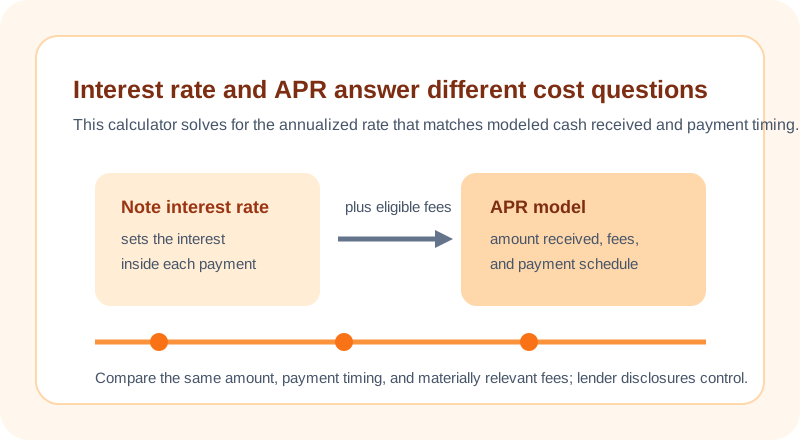
Worked scenario: the rate can stay at 8% while the effective estimate rises
Assume a $10,000 loan at a stated 8% annual rate for 24 months with a $300 origination fee deducted from proceeds. The scheduled payment is $452.27 per month, calculated from the full $10,000. The borrower receives $9,700 after the fee. Solving the payment stream against $9,700 produces a modeled effective APR of about 11.04%.
That calculation does not decide whether the fee is allowed, required, or included in a lender's official APR for a particular product. It makes the cash-flow effect visible: the payment is tied to $10,000 while the amount received is $9,700. Compare the same fee treatment and payment timing when evaluating two offers.
Compare like with like before ranking offers
APR is most useful when you compare offers with the same loan amount, term, payment timing, and purpose. If one offer has a different term or a different amount received, the lower percentage might answer a different question from the one you care about. Put the rate, APR, payment, fees, amount financed, proceeds, and total of payments in the same worksheet.
The CFPB explains the distinction between a loan interest rate and APR: APR can include the rate plus additional lender charges. The actual offer disclosure is still the authority for what each lender has calculated and charged.
Why this page does not produce a legal disclosure
APR disclosure calculations can have transaction-specific rules for fees, timing, tolerances, points, insurance, prepaid items, and rounding. This calculator intentionally uses a clearly explained present-value model for a common deducted-fee scenario rather than presenting itself as a compliance engine. It cannot tell you whether a lender's disclosure is legally correct.
For example, the CFPB's Regulation Z material describes official mortgage Closing Disclosure content, including APR and finance-charge disclosures, in a regulatory context. Use the calculator to understand how a deducted fee can move a comparison, then obtain clarification from the creditor or an appropriate adviser for an actual document.
A practical APR comparison checklist
- Record the stated rate, loan amount, term, and payment for each offer.
- List every fee and whether it is deducted, financed, or paid separately.
- Compare the amount actually received with the amount being repaid.
- Use the same time horizon and amount for both scenarios.
- Read the official disclosure before signing, especially when short terms or large fees make the effective cost sensitive.
Use the Loan Calculator to inspect a fixed payment schedule and the Auto Loan Calculator when the amount financed includes vehicle-specific credits and fees. Report a calculator issue with sample values only; do not upload or paste private disclosures.