
Loan Calculator
Model a fixed-rate installment-loan payment, schedule, total modeled interest, optional origination-fee effect, and voluntary extra-payment scenario from the amount, rate, and term you enter. Keep the result alongside the lender's actual disclosure.
Example Loans
Personal Loan
$20,000 • 10% • 5 yr
Auto Loan
$35,000 • 7.5% • 6 yr
Student Loan
$30,000 • 6% • 10 yr
Large Loan
$50,000 • 9% • 7 yr
Loan Details View Results
Your Loan Summary
| Amount financed | $0 |
Balance & Interest Over Time
What If I Pay Extra Each Month?
| Extra / mo | Payoff time | Total interest | Interest saved |
|---|
Amortization Schedule
| # | Date | Principal | Interest | Balance | Cum. Interest |
|---|
How This Is Calculated
Payments use the standard amortization formula M = P · r(1+r)ⁿ / ((1+r)ⁿ − 1), with your own numbers plugged in:
Check the method before you use the estimate
This page documents the formula, assumptions, and any specific external sources used for this tool.
See the methodPlanning estimate What this result can and cannot tell you
Educational fixed-loan estimate only. This is not financial advice, a loan offer, approval, or legal disclosure. Confirm the lender's rate, APR, amount financed, fees, payment schedule, prepayment terms, and total obligations before accepting credit.
How the Loan Calculator works
These notes describe the calculation used on this page and the assumptions that can change a real-world result.
M = P * [r(1 + r)^n] / [(1 + r)^n - 1]; each month, interest = opening balance * r and principal = payment - interest + selected extra principal. For a deducted fee, the effective-APR estimate solves the payment stream against proceeds = principal - fee.
Assumptions on this page
- The schedule assumes a fixed annual rate, equal monthly payments, and the term entered. It does not model variable rates, payment holidays, late charges, collateral, or lender-specific rules.
- A fee is an input used for a planning effective-APR estimate; this tool is not a legal Truth-in-Lending disclosure calculation.
- Extra payments are modeled as principal reductions after the month's scheduled interest. Real lenders can have separate posting rules, fees, or prepayment terms.
- The result is not an offer, approval, affordability decision, or personal borrowing recommendation.
Sources used on this page
- CFPB: Difference between a loan interest rate and APR Used for the distinction between the stated interest rate and an APR that can include additional loan charges.
- CFPB: Truth-in-Lending disclosure for an auto loan Used for the reminder that actual closed-end credit disclosures identify APR, finance charge, amount financed, payment, and other binding terms.
Everything behind the Loan Calculator
Formulas, reference charts, and detailed answers — expand any section you need.
Use one clear loan definition before comparing payments
An installment-loan payment only has meaning when the amount, annual rate, term, and fees describe the same offer. Enter the amount you expect to owe, the rate used to calculate the scheduled payment, and the number of months. If an origination fee is deducted from the proceeds, enter it separately so the page can show why the amount received can differ from the amount repaid.
This page is designed for a fixed-rate, equal-payment scenario. It is not a lender portal and cannot know whether a fee is financed, deducted, optional, refundable, or legally included in a disclosed APR. Use the result to organize a comparison, then review the actual disclosure. For a focused fee-and-rate view, use the APR Calculator.
The fixed-payment equation and monthly schedule
The core payment equation uses P for the balance, r for the annual rate divided by 12, and n for the number of monthly payments:
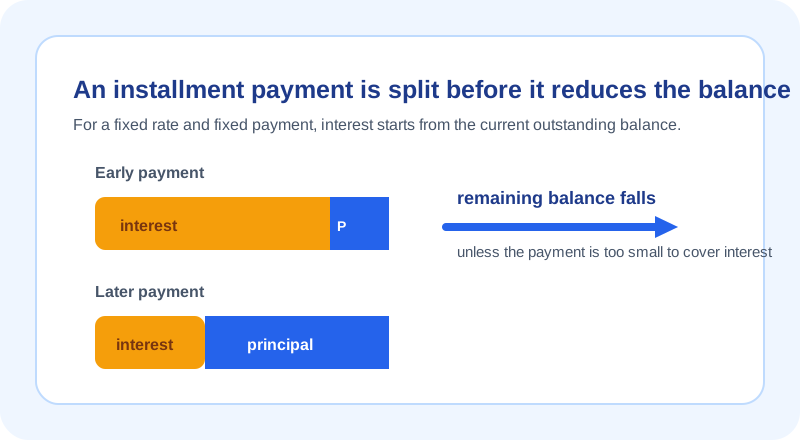
After the payment is calculated, each row in the schedule first calculates interest from that month's opening balance. The rest of the scheduled payment is principal. A lower balance means later interest is calculated on a smaller number, so the principal share grows in a typical fixed-rate schedule.
Worked scenario: recreate a payment before reading the total
Suppose a borrower models $12,000 at a fixed 10% annual rate for 36 months. With r = 0.10 / 12 and n = 36, the payment equation gives $387.21 per month. Multiplying that payment by 36 produces about $13,939.42 of scheduled payments, so the modeled interest is about $1,939.42 before any separately entered fee.
The point of the example is not that 10% is a suitable rate. It is that the result can be checked from the inputs. If the lender deducts a fee from the $12,000 proceeds, the borrower may receive less cash while making payments calculated on the full $12,000 balance. Enter that fee visibly and compare the cash received, payment, and stated APR rather than looking at one figure alone.
Term length changes both payment pressure and interest exposure
For the same principal and rate, a longer term spreads repayment over more months. That generally reduces the monthly payment but can increase total modeled interest because the balance stays outstanding longer. A shorter term raises the payment and can shorten the interest path. Neither output answers whether the payment fits your budget or whether the credit is available.
Run at least two terms using the same amount and rate. Then compare the payment with a real household budget, not only with a lender's maximum. The Budget Calculator is a separate place to record recurring obligations, and the Amortization Calculator can show the schedule behind one selected term.
Fees and extra payments should not be hidden in the comparison
When a fee is deducted from proceeds, this page models an effective annualized rate by solving for the monthly rate that makes the payment stream equal the smaller amount received. That is useful for understanding the direction of the fee effect, but it is not a substitute for the lender's disclosed APR or a legal calculation under every credit rule.
Extra payment fields are also scenario tools. The page adds an extra monthly or one-time amount to modeled principal after calculating that month's interest. Confirm whether the lender accepts extra payments, how it posts them, whether it advances the due date, and whether any agreement terms apply. Do not rely on a general schedule to override a contract.
Compare the actual disclosure before accepting credit
The CFPB explains that a Truth-in-Lending disclosure can identify APR, finance charge, amount financed, payment, and other important terms. The exact document and rules differ by transaction, but the comparison habit is useful: line up like-for-like amount received, fees, rate, term, payment, and total required payments.
Use this calculator to detect a question, not to supply an answer the offer itself must provide. If a formula, label, or calculation path appears inconsistent, report it through the issue form with non-sensitive sample inputs only.