
Auto Loan Calculator
Build a transparent auto-loan scenario from vehicle price, down payment, trade-in value and payoff balance, user-entered sales-tax treatment, fees, rate, and term. Review the amount financed before using the monthly payment to compare offers.
Example Deals
New Car w/ Trade-In
$32k • $3k down • $8k trade • 60 mo
Used Car
$22k • 10% down • 9.5% • 60 mo
72-Month Term
$45k • trade-in • 72 mo
Negative Equity
$3k rolled into new loan
Deal Details View Results
Your Auto Loan Summary
Term Comparison (48 / 60 / 72 months)
Balance & Interest Over Time
Amortization Schedule
| # | Date | Principal | Interest | Balance | Cum. Interest |
|---|
How This Is Calculated
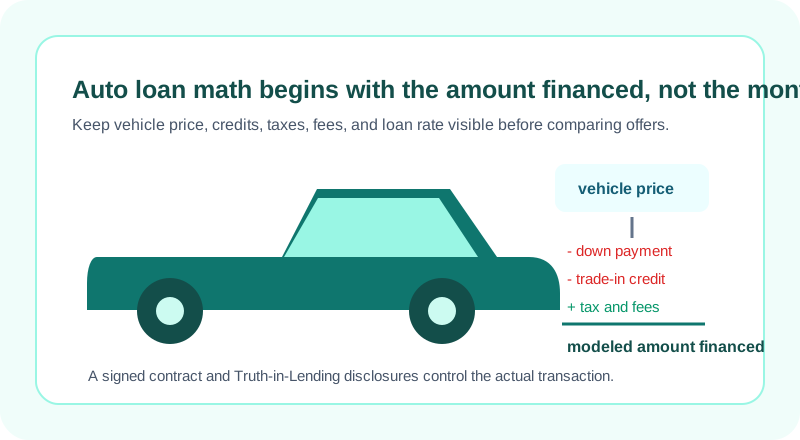
Amount financed equals vehicle price minus down payment and trade-in equity, plus sales tax and fees. The monthly payment uses M = P * r(1+r)^n / ((1+r)^n - 1) on that figure:
Check the method before you use the estimate
This page documents the formula, assumptions, and any specific external sources used for this tool.
See the methodPlanning estimate What this result can and cannot tell you
Educational auto-loan estimate only. This is not financial advice, a loan offer, purchase quote, or tax calculation. Confirm the vehicle price, payoff, trade terms, taxes, fees, APR, amount financed, payment schedule, and add-on products in the signed disclosures before proceeding.
How the Auto Loan Calculator works
These notes describe the calculation used on this page and the assumptions that can change a real-world result.
Trade-in equity = trade-in value - trade-in payoff; modeled amount financed = vehicle price - down payment - trade-in equity + entered sales tax + entered fees. Payment M = P * [r(1 + r)^n] / [(1 + r)^n - 1].
Assumptions on this page
- Vehicle price, down payment, trade-in value, payoff balance, sales-tax rate, taxable-trade-in treatment, fees, rate, and term are visitor inputs.
- The payment schedule assumes a fixed rate and equal monthly payments. It does not model rate changes, rebates, insurance, add-on products, registration, dealer policy, or a signed contract.
- Negative trade equity increases the modeled amount financed because the payoff exceeds the trade-in value.
- Sales-tax treatment differs by jurisdiction and transaction. The toggle is a planning assumption, not tax guidance.
Sources used on this page
- CFPB: What is a Truth-in-Lending disclosure for an auto loan? Used for the distinction between APR, finance charge, amount financed, and payment terms that lenders or dealers must disclose before a consumer signs.
- CFPB: Different ways to buy or finance a car or vehicle Used for the advice to compare financing sources and loan terms rather than relying on one dealer-arranged offer.
Everything behind the Auto Loan Calculator
Formulas, reference charts, and detailed answers — expand any section you need.
Check the amount financed before comparing the payment
A vehicle payment is calculated from the amount financed, not just from the advertised vehicle price. This page starts with the price and then keeps the entries that move the balance visible: down payment, trade-in value, trade-in payoff, sales-tax assumption, and fees. It converts the resulting amount financed into a fixed-rate schedule using the rate and term you enter.
That separation matters because a low-looking payment can hide a large balance, a long term, negative trade equity, or financed products and fees. The calculator cannot read a purchase order or decide which charges belong in your transaction. Use it as a worksheet, then compare the exact numbers with the dealer or lender disclosures.
How the amount financed is assembled
The trade-in line is first converted to equity: trade-in value minus the payoff on that vehicle. Positive equity reduces the modeled amount financed. Negative equity has the opposite effect because the existing payoff is larger than the value credited for the trade.
The sales-tax input is intentionally editable, including whether you want the trade value to reduce the taxable amount. Jurisdiction-specific tax treatment can differ, so do not use the toggle as a tax rule.
Worked scenario: show negative trade equity explicitly
Suppose a vehicle price is $30,000, the down payment is $4,000, the trade-in value is $8,000, and the existing payoff is $10,000. Trade-in equity is -$2,000. If the user enters a 6% tax rate applied after the $8,000 trade value and $500 of fees, tax is $1,320. The modeled amount financed is $30,000 - $4,000 - (-$2,000) + $1,320 + $500 = $29,820.
At a fixed 7% annual rate for 60 months, that amount produces a modeled payment of $590.47 per month. Neither number says the tax method, rate, fee, trade value, or approval is correct for a real deal. It demonstrates why the payoff on a trade must be visible instead of disappearing from the payment discussion.
Term comparisons are payment and total-cost comparisons
The page compares 48-, 60-, and 72-month schedules using the same modeled amount financed and rate. A longer term generally lowers the payment but keeps the balance outstanding for more months, which can increase total modeled interest. Do not compare a 60-month offer with a 72-month offer by payment alone; compare the amount financed, APR, term, and total of payments together.
The CFPB explains that an auto-loan Truth-in-Lending disclosure identifies important terms such as APR, finance charge, amount financed, and payment. The real disclosure controls. This calculator helps you make a short list of numbers to question and compare.
Shopping and transaction details outside this page
You may receive loan offers through a dealer, bank, credit union, or another provider. The CFPB's consumer guidance on dealer-arranged and direct financing explains why comparing sources and terms can matter. This page does not gather quotes or decide which lender is preferable.
It also does not include insurance, fuel, maintenance, repairs, registration, taxes not entered, service contracts, gap coverage, or other ownership costs. Add the modeled payment to a realistic budget with the Budget Calculator; a payment that fits a loan ratio may still not fit the rest of the household plan.
A document-led auto-loan check
- Copy the vehicle price, down payment, trade value, trade payoff, tax, and fees from the same proposed transaction.
- Confirm whether each fee is paid in cash or financed.
- Enter an offer-specific rate and the exact number of payments.
- Compare amount financed, APR, payment, finance charge, and total of payments across like-for-like offers.
- Keep the signed disclosure as the source of truth after purchase.
If the formula or explanation needs correction, report it through the issue form without sharing a VIN, account number, contract, or identifying information.