Asphalt Calculator
Estimate exactly how much asphalt you need for driveways, parking lots, roads, walkways, private lanes, and paving projects. Instantly calculate asphalt tons, volume, truckloads, and cost.
Example Projects
Paving Parameters View Results
For standard Residential Driveways, 2 to 3 inches of compacted asphalt is standard. A 4-inch base layer of gravel subbase is recommended.
Asphalt Estimates
View Calculation Breakdown
Detailed Measurements Live
| Asphalt Tonnage (Gross) | 0.00 tons |
| Net Weight (No Waste) | 0.00 tons |
| Waste Material Included | 0.00 tons (5%) |
| Total Pounds | 0 lbs |
| Cubic Yards | 0.00 yd³ |
| Cubic Feet (Loose) | 0.0 ft³ |
| Cubic Meters | 0.0 m³ |
| Paved Surface Area | 0 sq ft |
| Small Truckloads (~7.5 tons) | 0.0 loads |
| Standard Truckloads (~17.5 tons) | 0.0 loads |
| Large Truckloads (~25 tons) | 0.0 loads |
How this was calculated:
Everything behind the Asphalt Calculator
Formulas, reference charts, and detailed answers — expand any section you need.
How to Use the Asphalt Calculator
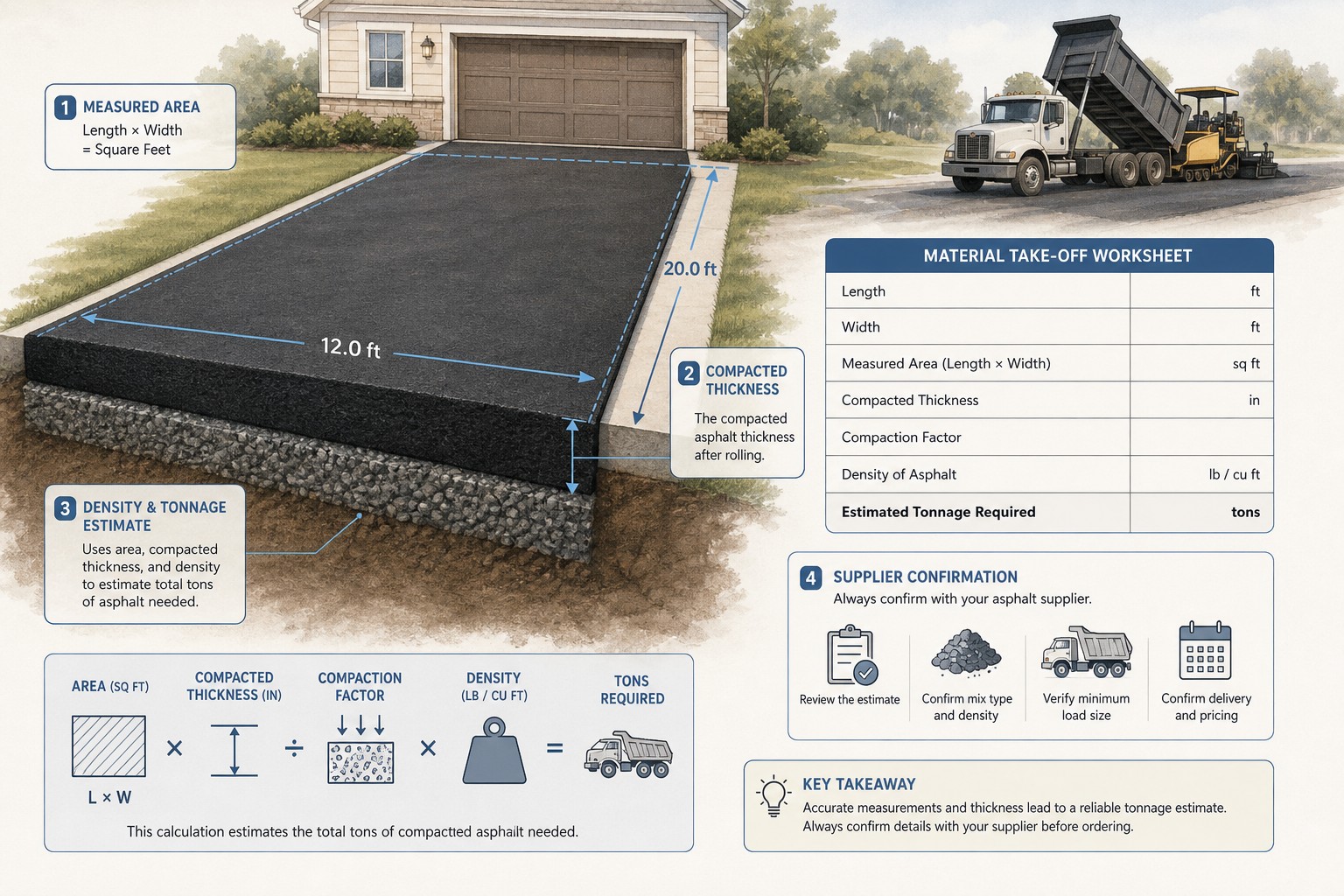
Using the Asphalt Calculator is simple. Enter your project length and width, select the target asphalt thickness from the options, choose a custom material density or use the standard 145 lb/ft³, apply a waste factor, and optionally enter pricing parameters. The calculator instantly estimates required asphalt tons, cubic yards, standard truckloads, and material cost.
What Is Asphalt?
Asphalt is a composite mixture of mineral aggregates (crushed stone, sand, or gravel), binder (bitumen), and filler materials. It is heated and mixed at high temperatures (Hot Mix Asphalt) before being laid on compacted stone aggregate bases and rolled to form a durable, smooth surface.
Common paving projects include driveways, highways, parking lots, pathways, play courts, and access lanes. Because it is highly recyclable and elastic, asphalt remains one of the most popular and cost-effective paving solutions globally.
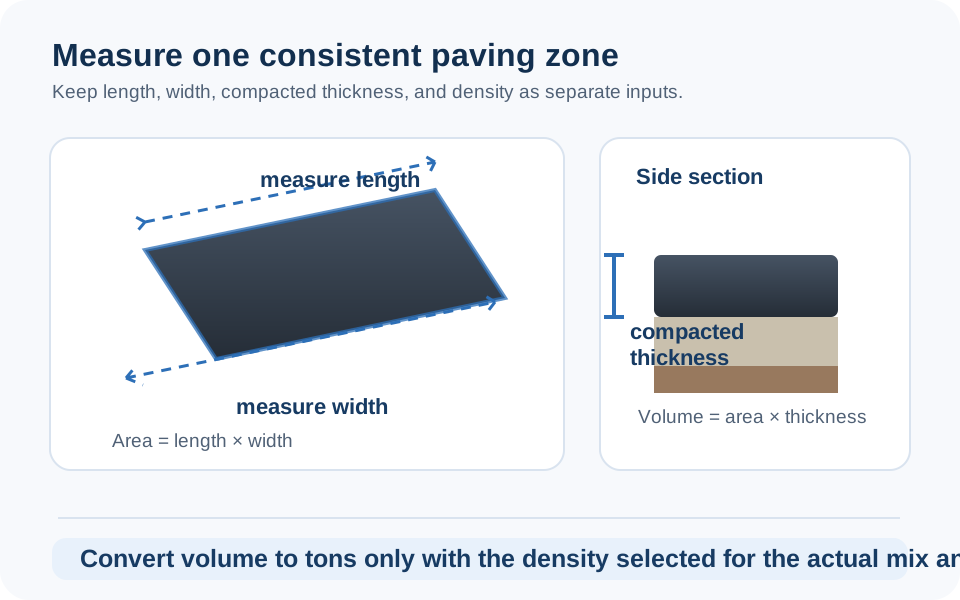
Asphalt Volume Formula
Volume is determined by multiplying the surface area by the compacted thickness:
Asphalt Weight Formula
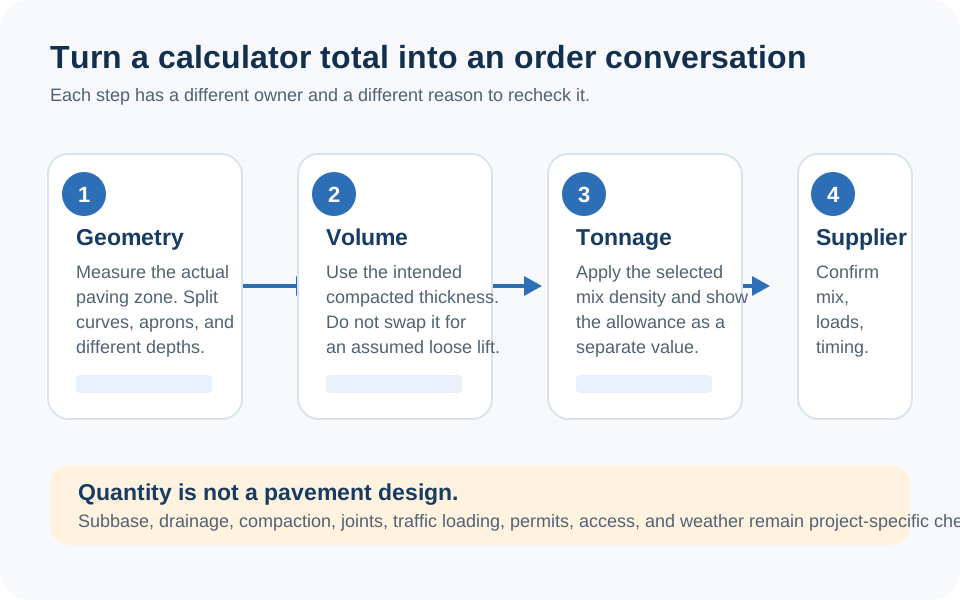
After volume is calculated, tonnage is determined by incorporating the density of the asphalt mixture:
Most asphalt hot mix plants and quarry suppliers sell material exclusively by the ton.
Asphalt Calculator for Driveways
Driveways are one of the most common residential asphalt applications. Standard residential driveways are typically paved at a compacted thickness of 2 to 3 inches over a gravel foundation layer. For driveways supporting heavy utility trucks or large RV motorhomes, a 4-inch compacted thickness is recommended.
Asphalt Calculator for Parking Lots
Commercial parking lots support standard vehicles, delivery vans, and garbage trucks. A compacted thickness of 4 inches is typical for parking bays, while main travel lanes and dumpster pads should be paved at 6 inches over a thick compacted aggregate subbase.
Asphalt Calculator for Roads
Roadways require maximum durability to resist heavy traffic loads and environmental cycles. Depending on traffic volumes, roads are paved at 4 to 8 inches, usually divided into a coarse aggregate binder course and a smooth fine-textured wear surface course.
Recommended Asphalt Thickness Guide
Pavement life depends on correct thickness. Refer to standard specifications:
- Pedestrian Walkway: 2 inches of compacted asphalt.
- Residential Driveway: 2 to 3 inches of compacted asphalt.
- Heavy Utility Driveway / RV Pad: 4 inches of compacted asphalt.
- Commercial Parking Lot: 4 to 6 inches of compacted asphalt.
- Roadway / Access Lane: 4 to 8 inches of compacted asphalt.
Asphalt Density Chart
Different asphalt mixes vary in aggregate size and air void specifications, which affects compaction density:
- Standard Hot Mix Asphalt: ~145 lbs/ft³ (Typical residential and commercial mix).
- Dense-Graded Asphalt: ~148 lbs/ft³ (Heavy-duty roadway binder courses).
- Porous / Open-Graded Asphalt: ~140 lbs/ft³ (Designed to allow stormwater drainage).
Asphalt Cost Estimator
On average, asphalt materials cost between $80 and $180 per ton. Factors influencing total paving budgets include:
- Oil Prices: Bitumen is a petroleum byproduct; liquid asphalt prices fluctuate with crude oil indexes.
- Regional Distance: Hot mix asphalt must be laid while hot (typically 275°F to 300°F), meaning transport times limit delivery radiuses.
- Labor & Machinery: Excavation, grading, aggregate subbase layers, heavy steam rollers, and paving machines represent a significant portion of paving expenses.
Truckload Capacity Guide
Budgeting shipping loads ensures hot asphalt arrives continuously to prevent cold joints:
- Small Dump Truck: 5 to 10 Tons capacity.
- Standard Dump Truck: 15 to 20 Tons capacity.
- Large Commercial Paving Truck: 20 to 30 Tons capacity.
Common Asphalt Project Examples
- Driveway: A 40 ft × 12 ft driveway paved at 3 inches thickness requires ~3.78 tons of asphalt (at 145 lbs/ft³, with 5% waste).
- Walkway: A 50 ft × 4 ft walkway paved at 2 inches thickness requires ~1.31 tons.
- Parking Lot: A 100 ft × 80 ft parking bay paved at 4 inches needs ~106.33 tons.
- Private Road: A 300 ft × 12 ft access lane paved at 4 inches needs ~47.85 tons.
Frequently Asked Questions
How much asphalt do I need?
The required quantity depends on your area size and thickness. For example, a 20ft × 20ft space paved at 2 inches thickness requires approximately 3.05 tons of asphalt.
How many tons of asphalt do I need?
The calculator converts your project dimensions into tonnage. It multiplies your area cubic feet by the asphalt density (standard is 145 lbs/ft³), and then divides the total pounds by 2,000.
What is the standard asphalt thickness for a driveway?
For residential driveways, a compacted thickness of 2 to 3 inches is standard. This should always be paved over a solid, compacted gravel base of 4 to 6 inches for drainage and stability.
How much does asphalt weigh?
Standard hot mix asphalt weighs approximately 145 pounds per cubic foot. This equals about 3,915 pounds (approx. 1.95 tons) per cubic yard.
How much does asphalt cost per ton?
Hot mix asphalt materials generally cost between $80 and $180 per ton. Complete professional paving installation (labor, base preparation, paving, compaction) averages $3.50 to $7.00 per square foot.
How many tons fit in a dump truck?
Most standard commercial dump trucks carry between 15 and 20 tons of hot mix asphalt, while smaller utility trucks carry 5 to 10 tons.
Can I use this calculator for parking lots?
Yes. The calculator works for residential driveways, commercial parking lots, public roads, pathways, and private lanes.
What is the difference between asphalt and concrete?
Asphalt is generally less expensive, quicker to install, and flexible under freeze-thaw cycles, but requires sealcoating. Concrete has a longer lifespan, requires less maintenance, but is more expensive and prone to cracking under shifting soils.