
Interest Calculator
Explore simple interest, compound growth, recurring monthly contributions, and target calculations with your own rate, time, frequency, and timing assumptions. The result is mathematics from those inputs, not a forecast or a promise of an account return.
Example Scenarios
Savings
$10k • 5% • 10 yr
CD
$25k • 4.5% • 5 yr
Monthly Deposits
$5k + $200/mo
Long Term
$10k • 7% • 20 yr
Interest Details View Results
Growth Analysis
Growth Over Time
Compounding Frequency Comparison
| Frequency | Final Balance | Interest |
|---|
Year-by-Year Growth
| Year | Start | Contributions | Interest | End |
|---|
How This Is Calculated
Compound interest uses A = P(1 + r/n)nt, with your own numbers plugged in:
Check the method before you use the estimate
This page documents the formula, assumptions, and any specific external sources used for this tool.
See the methodPlanning estimate What this result can and cannot tell you
Educational interest-growth estimate only. This is not financial advice, investment advice, banking advice, or tax advice, and it does not predict a future rate or return. Confirm account terms, compounding method, deposit timing, fees, limits, taxes, and current rates with the relevant provider before relying on a result.
How the Interest Calculator works
These notes describe the calculation used on this page and the assumptions that can change a real-world result.
Simple interest: I = P * r * t. Lump-sum compound growth: A = P * (1 + r / n)^(n * t). With monthly contributions, the calculator simulates each month using an effective monthly rate derived from the selected compounding frequency and deposits at the selected start or end of month.
Assumptions on this page
- Rate, time, compounding frequency, monthly contribution, and contribution timing are user-entered assumptions.
- The compound and contribution paths assume the entered rate is constant for the entire modeled period and that deposits occur as selected with no fees, withdrawals, taxes, rate changes, limits, or account rules.
- Target-date and required-payment results are numerical solves under the same assumptions, not commitments, advice, or forecasts.
- The calculator does not identify a suitable product, guaranteed yield, or investment return.
Sources used on this page
- CFPB: Difference between a loan interest rate and APR Used for the plain-language distinction that an interest rate is a cost of borrowing principal and that APR can be a broader annual borrowing-cost measure.
- CFPB: What is an APR and why can it be high on a short-term loan? Used for the reminder that time and annualization matter when comparing percentage-based borrowing costs.
Everything behind the Interest Calculator
Formulas, reference charts, and detailed answers — expand any section you need.
Choose the interest model before interpreting the result
“Interest” can mean several different calculations. Simple interest applies a rate to the original principal for a stated time. Compound interest applies interest to a growing balance. When monthly deposits are included, deposit timing also matters because a deposit at the beginning of a month can earn that month's modeled interest while one at the end does not.
This page makes those choices explicit. Select simple, compound, contribution, or target mode, then enter your own rate, time, frequency, and payment timing. The output is a mathematical result from those assumptions. It does not know what account, loan, investment, or product you have, and it does not imply a rate will remain constant.
The formulas behind simple and compound growth
For simple interest, the calculation is direct: interest equals principal × annual rate × time in years. For a lump sum with periodic compounding, the page uses A = P(1 + r/n)nt, where n is the number of compounding periods per year.
With monthly contributions, the page simulates one month at a time using an effective monthly rate derived from the frequency selected. That lets it keep a start-of-month deposit distinct from an end-of-month deposit.
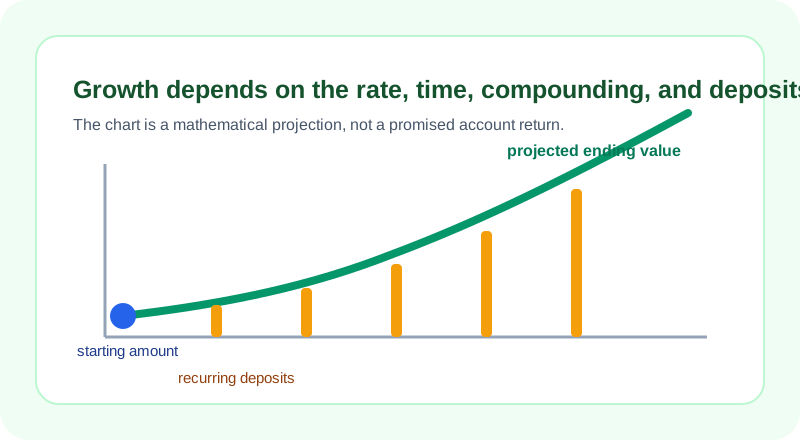
Worked scenario: same starting amount, different model
Start with $10,000, an annual 5% rate, and five years. Simple interest is $10,000 × 0.05 × 5 = $2,500, for an ending amount of $12,500. Monthly compounding under the same constant-rate assumption gives $10,000 × (1 + 0.05/12)60 = about $12,833.59.
The $333.59 difference is not a promise of an account return. It is the mathematical effect of assuming that each month's interest remains in the balance and earns later interest. Add a monthly contribution and the page will also track the deposits separately from the modeled interest, which is useful when checking whether a target comes mostly from saving more or from the selected rate assumption.
Frequency and deposit timing are modeled details
The page lets you compare annual, semiannual, quarterly, monthly, and daily compounding for a lump-sum scenario. At a fixed stated annual rate, changing frequency changes how the formula applies that rate within a year. The difference can be small over a short period and larger over a longer one, but it must be read alongside the product's actual compounding convention.
For contributions, the page applies them at the beginning or end of each modeled month. That is why two savings plans with the same annual total can have different outputs. The settings are transparency controls, not evidence that a bank or investment account credits interest exactly that way. Read the provider's account terms for the actual convention.
Target results expose the assumption, not the outcome
In target mode, the calculator can either solve for the time needed to reach an amount or solve for the recurring monthly contribution required for a chosen time. Both are numerical answers under the rate, frequency, contribution timing, and no-withdrawal assumptions you enter. Change any of those inputs and the result changes.
That is useful for planning a savings conversation but not for predicting markets, determining how much risk to take, or choosing an account. Use the Savings Goal Calculator for a goal-specific schedule, or the Loan Calculator when the rate describes borrowing rather than a balance that is expected to grow.
A transparent interest checklist
- Confirm whether you need simple interest, compound growth, or an installment-loan calculation.
- Record the rate source, its date, and whether it is fixed, variable, quoted, or assumed.
- Check the selected compounding frequency against the product terms.
- Label every monthly deposit and withdrawal assumption separately from interest.
- Run a lower-rate or no-growth scenario before relying on a target result.
If an equation, figure, or explanation needs correction, submit a non-sensitive sample through the issue form. Do not include account identifiers or private statements.