
Compound Interest Calculator
Calculate a compound-growth scenario from the principal, rate, time, compounding frequency, monthly contribution, deposit timing, and annual contribution-increase inputs you enter. It is a mathematical model, not a return forecast or savings-product quote.
Example Scenarios
Savings Growth
$10k • 5% • 10 yr
Long Term
$10k • 7% • 20 yr
Monthly Deposits
$200/mo • 7% • 30 yr
Principal + Deposits
$5k + $100/mo • 6%
Growth Details View Results
Compound Growth Results
Growth Over Time
Compounding Frequency Comparison
| Frequency | Final Balance | Interest |
|---|
Year-by-Year Growth
| Year | Start | Contributions | Interest | End |
|---|
How This Is Calculated
Compound interest uses A = P(1 + r/n)nt for the starting principal, plus month-by-month compounding for any deposits. Your numbers are plugged in below:
Check the method before you use the estimate
This page documents the formula, assumptions, and any specific external sources used for this tool.
See the methodPlanning estimate What this result can and cannot tell you
Educational calculation only. This page does not predict investment performance, quote a bank rate or APY, recommend a product or account, or provide financial, tax, legal, or investment advice. Confirm actual terms and risks with the relevant provider. This is not financial advice.
How the Compound Interest Calculator works
These notes describe the calculation used on this page and the assumptions that can change a real-world result.
For a principal without deposits: A = P(1 + r/n)^(n×t). The calculator also simulates monthly deposits using the selected contribution timing and can raise the monthly deposit annually by the entered percentage.
Assumptions on this page
- Principal, annual rate, time, compounding frequency, monthly deposit, deposit timing, and contribution increase are user-entered inputs.
- The entered rate is applied consistently in the model. Actual accounts and investments can have changing rates, losses, fees, limits, taxes, minimums, and product-specific terms.
- The annual percentage yield display is a mathematical effective-rate conversion from the entered nominal rate and compounding frequency; it is not a product quotation.
- The comparison with simple interest uses the specified mathematical assumption and does not identify which product, contract, or investment is suitable.
Sources used on this page
- U.S. Securities and Exchange Commission: Investor.gov Compound Interest Calculator Supports using an initial amount, recurring contribution, time, estimated annual rate, variance range, and compounding frequency as explicit scenario inputs.
Everything behind the Compound Interest Calculator
Formulas, reference charts, and detailed answers — expand any section you need.
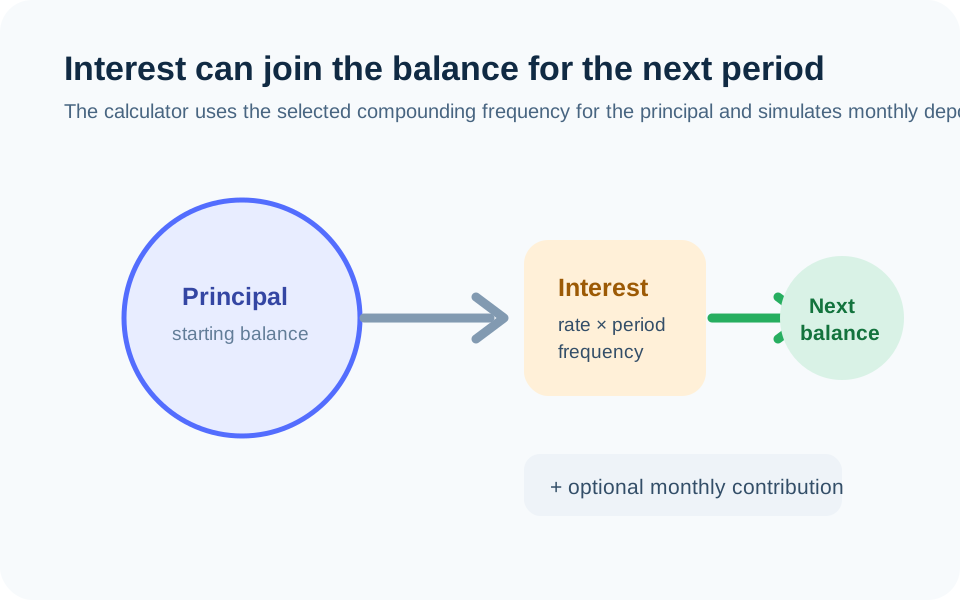
Compound interest changes the balance used in the next period
Compound growth begins with a principal amount. At each compounding period, interest is calculated from the balance at that point. When interest remains in the balance, a later period can calculate interest on the original principal and prior credited interest. The standard no-deposit form is A = P(1 + r/n)nt, where P is principal, r is annual rate as a decimal, n is periods per year, and t is years.
This calculator makes the other inputs visible: time, frequency, monthly deposits, whether a deposit arrives at the start or end of the month, and an optional annual increase in contributions. It is not a rate quote, account statement, or forecast.
Check a simple no-deposit example
For a principal of $1,000 at 6% annual rate compounded annually for two years, the calculation is $1,000 × (1 + 0.06)2 = $1,123.60. The $123.60 is the modeled interest. If the same rate, time, and principal were modeled with a different compounding frequency, the arithmetic would change because the periodic rate and count of periods are different.
With monthly deposits, a single formula line is less transparent because the balance changes each month. The calculator simulates those deposits under your selected timing. That is why an end-of-month deposit and a start-of-month deposit can produce slightly different outputs under the same annual rate.
Rate, APY, and compounding frequency should not be blended together
A nominal annual rate and an annual percentage yield are related but not interchangeable labels. A stated APY incorporates the effect of a stated compounding arrangement over a year; a nominal rate needs its compounding frequency to determine the effective annual result. This calculator shows the mathematical conversion for the values you enter, but it cannot tell you which disclosure applies to a bank or investment product.
Before using a product’s rate in a scenario, confirm whether the provider states a nominal rate or APY, how often interest compounds or credits, whether the rate can change, whether balances have tiers, and whether withdrawals or fees affect earnings. Those contract terms belong to the provider’s current disclosure.
Contributions are not “interest”
The page separates total contributions from modeled interest so you can see the source of the final balance. If you deposit $100 every month, the total contributed amount rises even if the return assumption is 0%. A higher final value may therefore come from deposits, modeled growth, or both. Do not compare final balances without first checking that contribution totals and timelines match.
Use the Savings Goal Calculator when the question is “what monthly deposit reaches a named goal by a chosen date?” Use the Investment Calculator when you want to test a broader investment scenario with sensitivity and inflation assumptions. The inputs must still be explicit in either tool.
Simple interest is a useful contrast, not a product recommendation
Simple interest calculates interest from the original principal without adding prior interest to the base: I = P × r × t. The Compound Interest Calculator can show a mathematical comparison, but that does not tell you whether a particular loan, certificate, savings account, or investment uses one method or another. Read the applicable agreement.
For a focused formula check, visit the Simple Interest Calculator. If you are evaluating a certificate of deposit, use the CD Calculator only after checking the issuer’s current APY, term, compounding, maturity, renewal, and early-withdrawal disclosures.
Match the scenario to the rate’s actual time period
A rate can be advertised, quoted, credited, or calculated on different time bases. Before entering it, note whether the source calls it an annual rate, a periodic rate, an APY, or something else. Then choose the compounding setting that the disclosure actually states. A mathematically correct calculation with a mismatched label is still the wrong scenario for the product.
Keep deposits separate from interest in your records. If you increase a contribution each year, write down the change date and amount. The calculator can apply an annual increase mechanically, but it cannot know whether the additional cash will be available or whether another goal must take priority. Revisit the scenario after a rate or contribution changes.