
Cash-Out Refinance Calculator
Model how a cash-out refinance could replace an existing mortgage balance, add requested cash and optional rolled-in closing costs, and compare the resulting schedule with simplified HELOC and home-equity-loan scenarios.
Example Scenarios
Repricing Trap
5.5% → 6.9% • $60k cash
80% Cap Scenario
$500k home • ~$98k max
Low-Rate HELOC Scenario
3.25% mortgage • $50k cash
High Rate Cash-Out
7.5% → 6.25% • $40k cash
Cash-Out Details View Results
Cash-Out Analysis
Cash-Out vs HELOC vs Home Equity Loan
| Option | Total Monthly | Added Interest | Lifetime Interest |
|---|
Payment and Payoff Comparison
| Current payoff date | – |
| New payoff date (cash-out) | – |
Interest Attribution Breakdown
How This Is Calculated
The cap-based cash scenario = selected LTV cap times home value minus your balance and any rolled-in closing costs. The modeled interest difference compares remaining interest on the current schedule with total interest on the new schedule, then splits that difference between cash interest and repricing the existing balance. It does not include costs not entered into the model.
Check the method before you use the estimate
This page documents the formula, assumptions, and any specific external sources used for this tool.
See the methodPlanning estimate What this result can and cannot tell you
Educational borrowing comparison only. This is not financial advice, a loan offer, appraisal, credit decision, or advice to use home equity. Confirm current lender terms, fees, rate type, repayment structure, lien position, and the consequences of securing debt with your home before acting.
How the Cash-Out Refinance Calculator works
These notes describe the calculation used on this page and the assumptions that can change a real-world result.
At a selected LTV cap c, modeled maximum cash = max(0, home value * c - current balance); when percentage closing costs f are rolled into the final loan, it uses max(0, home value * c * (1 - f) - current balance). New loan with rolled percentage costs = (current balance + cash out) / (1 - f).
Assumptions on this page
- The LTV cap, home value, existing balance, rates, terms, and closing costs are planning inputs. The calculator does not obtain an appraisal or lender policy.
- The cash-out, home-equity-loan, and HELOC comparisons use fixed-rate, fully amortizing payment schedules for the selected terms. A real HELOC may have a draw period, variable rate, fees, payment changes, or different terms.
- The comparison focuses on modeled payment and interest schedules. It does not model taxes, insurance, transaction charges beyond the entered closing cost, credit qualification, or product availability.
- A lower displayed incremental cost is not a recommendation to borrow against a home.
Sources used on this page
- CFPB: Mortgage refinance key terms Used for the explanation that a refinance replaces an existing mortgage and can be used to borrow additional money.
- CFPB: What is a home equity loan? Used for the definition of home equity as property value minus existing mortgage debt and for the reminder that borrowing against a home carries repayment and foreclosure risk.
- CFPB: What is a HELOC? Used for the limitation that a real HELOC can have a draw and repayment period, variable rate, and changing payments.
Everything behind the Cash-Out Refinance Calculator
Formulas, reference charts, and detailed answers — expand any section you need.
Cash-out refinance changes the entire mortgage balance
A cash-out refinance is not a small add-on to the old mortgage in this model. It replaces the remaining first-mortgage balance with a new loan. The new balance can contain the payoff balance, the cash requested, and closing costs if you elect to finance them. That is why a comparison needs to look beyond the cash portion: the replacement rate and term can reprice the existing balance as well.
This page keeps the parts visible and also creates simplified comparison paths for a HELOC and a home-equity loan. It does not decide which product is available or appropriate. Use it to organize questions and scenarios, then review real quotes and terms. For a no-cash-out replacement schedule, start with the Mortgage Refinance Calculator.
How the selected LTV cap becomes a cash scenario
The calculator begins with the home value and a user-selected loan-to-value (LTV) cap. Without financed percentage closing costs, it models the maximum cash as: home value × selected cap - current balance. If the result is negative, the available cash is shown as zero. If a percentage closing cost is rolled into the final loan, the model reduces the available cash so that the new balance still fits the selected cap.
This is transparent arithmetic, not an appraisal rule. Actual caps, valuations, lien treatment, fees, and approval depend on the product and lender.
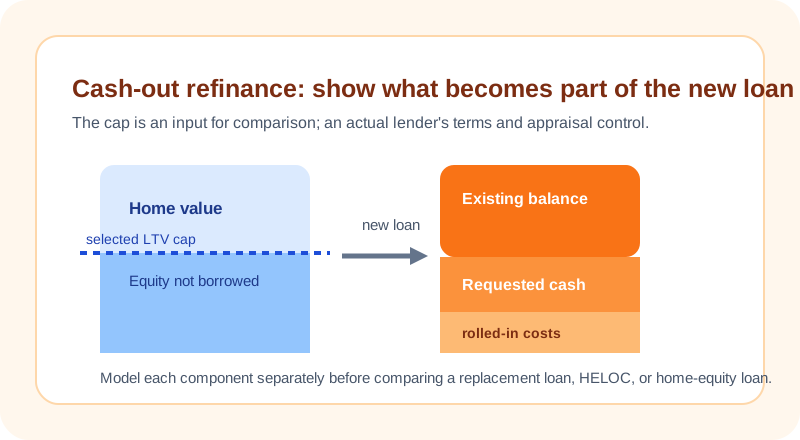
Worked scenario: separate cash from the replacement balance
Assume a $400,000 user-entered home value, a $220,000 current balance, and an 80% selected cap. The cap loan is $320,000, leaving a simple pre-cost cash scenario of $100,000: $320,000 - $220,000. If the page models 3% closing costs rolled into the final loan, it uses $320,000 × 0.97 - $220,000, which produces $90,400 of modeled maximum cash.
That difference illustrates why financing costs should not disappear from the analysis. If you request less cash, the new loan is still calculated from the remaining balance plus your cash and any rolled-in cost. Test the new rate and term against the current remaining schedule; a payment change can come from rate, term, balance, or all three.
Why a HELOC or home-equity loan is not the same schedule
A cash-out refinance replaces the first mortgage in this model. A home-equity loan is modeled as a separate fixed payment added to the existing mortgage payment. A HELOC is also represented as a separate payment for comparison, using the rate and term you enter. These are intentionally simplified paths so the extra borrowing is not hidden inside a single total.
The real products may behave differently. The CFPB explains that a HELOC can have a draw period and a repayment period, and often has a variable interest rate. This calculator does not simulate those features. Use the Home Equity Calculator to inspect equity and combined lien inputs separately.
Read the displayed “cost” as a model, not a verdict
The page compares modeled remaining interest on the current schedule with modeled interest after replacement. It also identifies a cash-interest component, a repricing component for the old balance, and financed-cost interest when applicable. These labels help explain why the result moves when you change the rate or reset the term.
They are not a complete transaction cost. They do not include a future rate change, HELOC draw behavior, a lender-specific fee schedule beyond the entered cost, insurance, tax treatment, a property-value change, or a resale timeline. The CFPB's home-equity-loan guidance is useful context: home equity is collateral, and repayment risk needs to be considered alongside payment math.
Check these details before relying on any comparison
- Use an actual current payoff balance and record its date.
- Enter an offer-specific new rate, term, cash request, and closing-cost treatment.
- Keep the selected LTV cap clearly labeled as an assumption until an appraisal and lender terms are known.
- For a HELOC, ask about draw-period payments, rate variability, annual fees, conversion options, and repayment-period changes.
- Compare all paths using the same cash amount and a realistic time horizon.
If the page's arithmetic, terminology, or source note needs correction, report it with non-sensitive sample values through the built-in issue form.