
Should I Refinance My Mortgage? How to Calculate the Break-Even Point
Use a refinance break-even calculation as one decision check, then compare Loan Estimates, term length, cash to close, principal, points, and three realistic time horizons.

Refinancing replaces one mortgage with another. A lower advertised rate can be useful, but it does not answer the full decision. The new loan can have lender charges, third-party costs, points, credits, a different balance, a different term, a different payment, and different total interest. A simple break-even point is a helpful first calculation—not a final verdict.
This guide shows how to calculate that first check, then how to compare the underlying documents and time horizons with the Mortgage Refinance Calculator. It is written for U.S. mortgage disclosures; local laws and products elsewhere can differ.
A lower payment is not automatically lower cost. It may come from a lower rate, a longer term, a lender credit exchanged for a higher rate, or costs added to the balance. Compare like with like before calculating savings.
The simple break-even calculation
When the current and proposed loans have comparable terms and the closing costs are paid in cash, a simple payment break-even formula is:
This calculation is only meaningful when the monthly reduction is positive and the cost number is clear. It does not automatically include a different loan balance, points, mortgage insurance, taxes, escrow, a cash-out amount, or a term extension.
Worked example: same remaining term, stated costs
Assume a borrower has a $240,000 remaining principal balance and 25 years left. The current fixed rate is 7%; a proposed refinance is 5% for the same 25-year term. In the standard fixed-rate monthly model, the current principal-and-interest payment is about $1,696.27 and the proposed principal-and-interest payment is about $1,403.02.
| Input | Current loan | Proposed loan |
|---|---|---|
| Principal used in model | $240,000 | $240,000 |
| Remaining / new term | 25 years | 25 years |
| Fixed rate used in model | 7% | 5% |
| Modeled principal-and-interest payment | $1,696.27 | $1,403.02 |
The modeled monthly principal-and-interest reduction is $293.25. If eligible cash closing costs are $5,400, the simple payment break-even is:
That is a narrow answer: it says when the accumulated payment reduction equals the stated upfront cash cost under the example’s assumptions. It does not prove that refinancing is right for a specific borrower.
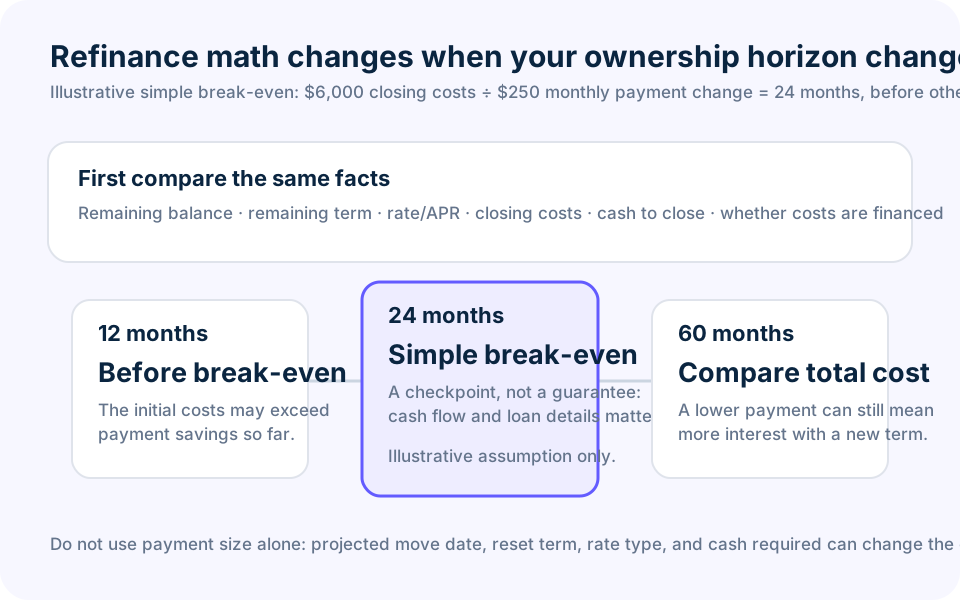
Compare three horizons, not one date
A better decision table tests the same proposal at several possible holding periods. In the worked example, the lower rate also changes the amount of principal remaining over time. At month 24, the standard model shows an approximate remaining balance of $232,391 on the current loan and $229,850 on the proposed loan. If the loan were sold or paid off then, that balance difference matters alongside payment cash flow.
| Horizon | Question to answer | Items to compare |
|---|---|---|
| Before simple break-even | What happens if the home is sold, the loan is paid off, or the plan changes early? | Cash closing costs, payment change, principal balance, and any prepayment or transaction costs. |
| Likely holding period | What is the expected result at the most realistic move, payoff, or refinance horizon? | Payment totals, remaining principal, fees, rate-lock assumptions, and product changes. |
| Long horizon / full term | What is the result if the new loan is kept for many years? | Total interest, total payment count, points, lender credits, and whether the new term restarts the repayment clock. |
Use matching horizons for both loans. A lower payment from resetting a nearly finished mortgage to a new 30-year term can look attractive in a one-month comparison while increasing total time in debt. That does not make the refinance automatically wrong; it means the comparison must make the tradeoff visible.
Read the Loan Estimate before using a headline rate
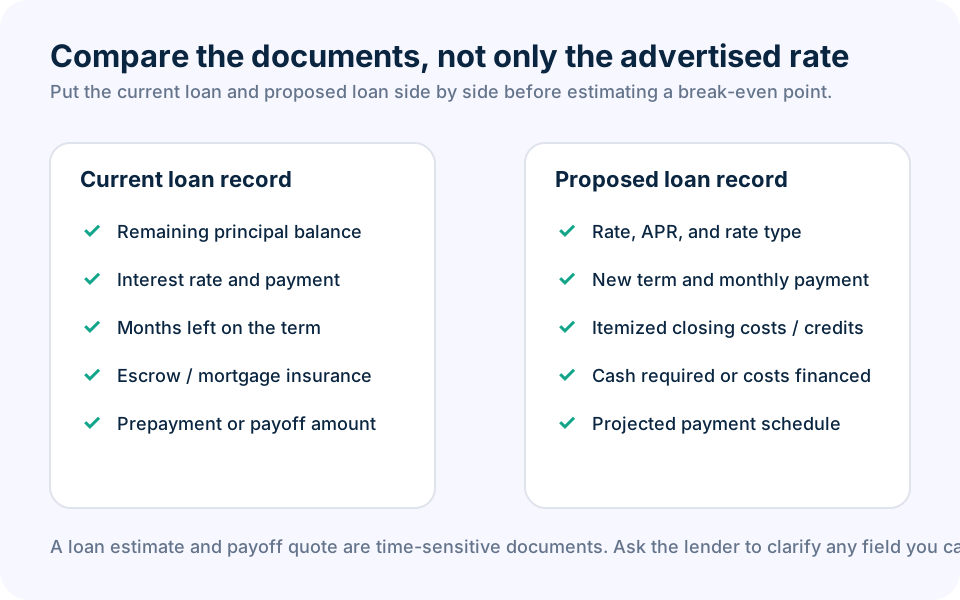
For a U.S. mortgage, request comparable Loan Estimates for the same loan type, term, occupancy, and rate-lock assumptions. The Consumer Financial Protection Bureau recommends comparing the documents rather than a verbal rate quote. Create a document check with these fields:
- Loan amount, term, loan type, and whether the rate is locked.
- Interest rate, APR, points, and lender credits.
- Principal-and-interest payment and total monthly payment, including mortgage insurance and escrow where shown.
- Origination charges, services that cannot be shopped for, services that can be shopped for, taxes, prepaids, and initial escrow.
- Cash to close, five-year cost-of-borrowing information, and total interest percentage where applicable.
- Any prepayment penalty, balloon feature, adjustable-rate terms, or change in mortgage insurance.
Do not add tax and insurance amounts to one offer while comparing them with principal-and-interest only on another. If taxes or insurance differ because of a different estimate, ask why; a lender does not control every cost on the document.
What “no-cost refinance” can mean
“No-cost” usually means that a cost has been financed, offset with a lender credit in exchange for a higher rate, or handled through another tradeoff. It does not mean there were no services or charges involved. Model a financed cost by increasing the new principal. Model a lender-credit option as its own rate-and-cost scenario. Then compare each option over the same horizons.
Use a calculator to keep inputs comparable
Enter the current principal balance, remaining term, rate, projected new rate, proposed new term, and cash closing costs in the Mortgage Refinance Calculator. Run at least two scenarios: one with the term held constant and another with the proposed term. Use the Amortization Calculator to compare remaining principal at your likely exit date, not just the monthly payment.
For a cash-out proposal, keep the cash received and the increased balance explicit. A cash-out refinance is not comparable to a rate-only refinance until that additional borrowing is shown separately.
Scope and limitations
This page is general educational information, not mortgage, legal, tax, or personalized financial advice. Its consumer-disclosure sources are U.S.-specific. Calculator examples use simplified fixed-rate monthly models and may not include escrow, taxes, insurance, changing rates, points, lender credits, cash-out proceeds, transaction costs, or individual eligibility. Review current written Loan Estimates and consult qualified local professionals for a personal decision.
Sources and assumptions
These links support the specific material, product, or reference points used in this guide. Local conditions and supplier specifications can still vary.
- Consumer Financial Protection Bureau — Should I Refinance? Explains that refinancing replaces an existing mortgage and involves tradeoffs, including the time needed to recover costs. This is U.S. consumer guidance.
- Consumer Financial Protection Bureau — Compare and Negotiate Loan Offers Supports comparing Loan Estimates, lender-controlled costs, total monthly payment, and five-year borrowing costs rather than relying on rate alone.
- Consumer Financial Protection Bureau — No-Cost or No-Closing-Cost Refinancing Explains that a lender credit can be exchanged for a higher rate or closing costs can be added to the loan; costs are not necessarily eliminated.
- Consumer Financial Protection Bureau — Loan Estimate Explainer Explains the standardized U.S. Loan Estimate and where to review loan terms, closing costs, points, credits, and comparison information.