
Home Equity Calculator
Calculate a transparent home-equity and combined-loan-to-value scenario from the property value, first-mortgage balance, second-lien balance, and a user-selected cap. Test a separate fixed-payment borrowing scenario without treating the result as an offer.
Example Scenarios
$450k Home
$280k mortgage • $80k tappable
80% LTV Comparison
$350k • 83% LTV
Existing HELOC
$320k + $40k HELOC
High Equity
$600k • 67% owned
Home Equity Inputs View Results
Equity Summary
Tappable Equity at All LTV Caps
| LTV Cap | Max Total Debt | Tappable Equity | Combined LTV |
|---|
Value Sensitivity (tappable at selected cap)
| Home Value | Change | Tappable Equity |
|---|
Borrowing Cost Breakdown
| Amount borrowed | — |
| Monthly payment | — |
| Total interest | — |
| Total repaid | — |
HELOC rates are often variable; this estimate prices a fixed-rate home equity loan on the drawn amount.
How This Is Calculated
Total equity is home value minus all loans. Tappable equity is (value × LTV cap) − total loans, floored at zero. The 80% card is only a current-value comparison; it does not determine mortgage-insurance cancellation or eligibility. Borrowing cost uses M = P · r(1+r)ⁿ / ((1+r)ⁿ − 1) on the amount borrowed.
Check the method before you use the estimate
This page documents the formula, assumptions, and any specific external sources used for this tool.
See the methodPlanning estimate What this result can and cannot tell you
Educational home-equity estimate only. This is not financial advice, an appraisal, credit decision, loan offer, or advice to borrow against a home. Verify value, liens, lender limits, payment structure, fees, rate risk, and repayment consequences with the relevant provider or qualified professional.
How the Home Equity Calculator works
These notes describe the calculation used on this page and the assumptions that can change a real-world result.
Total equity = max(0, home value - primary mortgage - second-lien balance); combined LTV = (primary mortgage + second-lien balance) / home value; modeled available amount at selected cap c = max(0, home value * c - total liens).
Assumptions on this page
- Home value, existing balances, selected LTV cap, rate, and term are entered by the visitor. The calculator does not obtain an appraisal, title search, lien status, or lender policy.
- The borrowing payment scenario assumes a fixed rate and a fully amortizing term. It does not model variable-rate, draw-period, fee, or product-specific features.
- The 80%, 85%, and 90% rows are comparative cap inputs within this calculator, not claims that a lender will make credit available at those levels.
- The result is a planning calculation, not a credit offer, appraisal, approval, or recommendation to use home equity.
Sources used on this page
- CFPB: What is a home equity loan? Used for the definition of equity as value minus existing mortgage debt and the explanation that a home equity loan uses the home as collateral.
- CFPB: What is a HELOC? Used for the limitation that a HELOC may allow repeated borrowing, may have a draw and repayment period, and often has a variable rate.
- CFPB: When can I remove private mortgage insurance (PMI)? Used for the limitation that a current-value 80% comparison alone does not establish mortgage-insurance cancellation or termination rights.
Everything behind the Home Equity Calculator
Formulas, reference charts, and detailed answers — expand any section you need.
Equity is an arithmetic starting point, not cash in hand
Home equity is the difference between a property's current value and the balances secured by it. This calculator keeps those components visible: enter the home value, first-mortgage balance, and any second-lien balance. It reports equity, primary loan-to-value (LTV), and combined LTV so you can see how the total debt relates to the value you entered.
That number is a planning snapshot. A property value can change, an appraisal can differ from an estimate, and a lender can consider title, lien priority, product rules, income, credit, payment history, costs, and other requirements. The page does not fetch any of those facts. Use the output to organize a question for a lender or counselor, not to assume funds are available.
How the equity and LTV calculations work
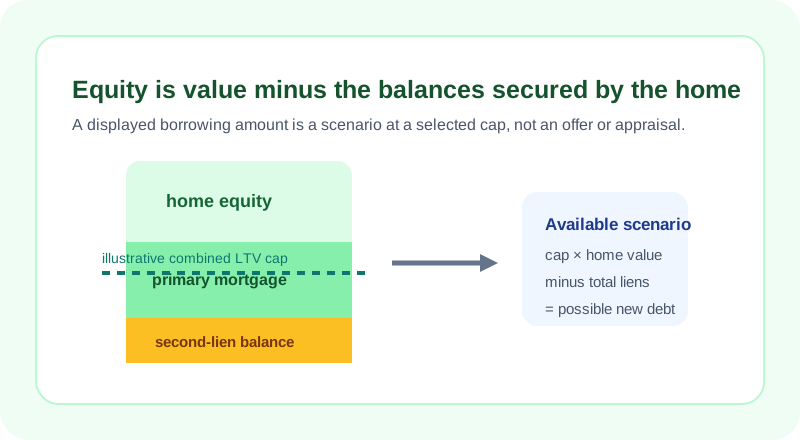
The calculation has only three core lines. It subtracts first and second liens from the entered value to get equity. It divides each relevant balance by value to show LTV. If you choose a cap for a borrowing scenario, it multiplies the value by that cap and subtracts all existing liens; a negative result is set to zero.
The cap is an input for sensitivity testing, not an eligibility promise.
Worked scenario: keep equity and possible new debt separate
Assume an entered home value of $500,000, a primary mortgage balance of $260,000, and a second-lien balance of $40,000. Total liens are $300,000, so the model reports $200,000 of equity and a combined LTV of 60%. If you test an 80% cap, the cap balance is $400,000. Subtracting the $300,000 of existing liens produces a $100,000 modeled available amount.
The $100,000 is not the same thing as equity, and it is not an offer. It is the amount left under that particular cap after the balances you entered. Change the home value, cap, or second-lien balance and the scenario changes immediately. For a replacement-first-mortgage scenario that includes cash, use the Cash-Out Refinance Calculator.
A home-equity loan and a HELOC need different questions
This page can estimate a fixed payment for a selected amount, rate, and term. That resembles an installment loan scenario, which is useful when checking a home-equity loan against the household budget. The CFPB describes a home equity loan as a lump sum secured by home equity, often with a fixed rate.
A HELOC is different: it can permit repeated borrowing during a draw period, may have a variable rate, and can have a later repayment phase with different payments. The fixed-payment box here does not replicate that lifecycle. Keep the actual product disclosure next to any calculator scenario.
Test the value and payment sensitivity, not just the largest line
The page includes a simple value sensitivity so you can see how a small change in the entered value changes a cap-based scenario. That is not a forecast of the market. It is a way to avoid treating one estimate as immovable. A lower value and the same balances raise LTV and reduce the space under the selected cap.
Do the same with a borrowing payment: test a rate and term change, then add the resulting payment to the existing mortgage and other obligations in a household budget. Use the Loan Calculator to inspect the payment schedule for a separately defined fixed-rate loan, and use the Mortgage Payoff Calculator when the question is accelerating the existing mortgage instead of taking on new debt.
Record the assumptions before discussing a borrowing option
- Write down where the property-value figure came from and its date.
- Use current payoff or statement balances for every lien you include.
- Label the selected LTV cap as an assumption until a lender supplies its own terms.
- For any borrowing scenario, record the rate type, term, fees, payment change rules, and collateral risk.
- Run a household-budget check with the new payment before relying on the displayed amount.
Use the page's issue form if its math, wording, or source note appears wrong. Please do not submit addresses, account numbers, statements, or other sensitive information.