
Debt Snowball Calculator
Estimate a smallest-balance-first debt payoff sequence from the balances, APRs, minimum payments, and monthly budget you enter. See how payment rollover changes the modeled order and compare it with avalanche using the same inputs.
Example Scenarios
$19,400 Debt Load
Four debts · $700/mo budget
Three Credit Cards
$12,900 total · $500/mo
$1,000 Lump Sum
One-time extra in month 1
Your Debts View Results
Snowball Results
Quick-Win Schedule
Growing Attack Payment
Snowball vs Avalanche on Your Debts
| Avalanche | Snowball | |
|---|---|---|
| Debt-free in | — | — |
| Total interest | — | — |
—
Balance Timeline
Month-by-Month Plan
How This Is Calculated
Each month interest accrues at rate ÷ 12 on every balance. Minimums go to all debts; everything left in your budget attacks the smallest balance. When a debt zeroes, its payment rolls into the next smallest and the attack payment grows.
Check the method before you use the estimate
This page documents the formula, assumptions, and any specific external sources used for this tool.
See the methodPlanning estimate What this result can and cannot tell you
Educational estimate only. A snowball sequence is not personalized financial, credit, legal, or debt-settlement advice. Verify current account terms and required payments with each creditor before acting. This is not financial advice.
How the Debt Snowball Calculator works
These notes describe the calculation used on this page and the assumptions that can change a real-world result.
Each modeled month adds balance × APR ÷ 12 to each unpaid balance, applies entered minimum payments, and sends the remaining debt budget to the smallest active balance. When it reaches zero, the available payment rolls to the next-smallest balance.
Assumptions on this page
- The model assumes balances, APRs, required minimums, and the total monthly budget stay unchanged unless you change them and rerun the calculator.
- It uses a monthly interest approximation before payments. It does not reproduce account-specific daily balance methods, due-date timing, fees, or payment allocation rules.
- The smaller-balance ordering is descriptive. The calculator does not decide which strategy fits a person’s circumstances.
- New borrowing, promotion expiration, settlement offers, credit reporting, taxes, and lender hardship programs are outside the calculation.
Sources used on this page
- Consumer Financial Protection Bureau: How to reduce your debt Supports the description of minimum payments, smallest-balance snowball ordering, highest-rate ordering, and rolling a freed payment into the next debt.
Everything behind the Debt Snowball Calculator
Formulas, reference charts, and detailed answers — expand any section you need.
What the debt snowball calculation changes
The snowball method changes the order of the extra payment. After the calculator applies the entered minimum payment to every active debt, it directs the part of your total monthly budget that remains to the smallest balance. Once that balance reaches zero, the amount previously used for it is available for the next-smallest balance in the next modeled cycle.
The plan still tracks APR for every debt because interest continues to accrue in the model while a balance is unpaid. A snowball result is therefore not a “zero-interest” calculation; it is a different payment priority using the same debts and budget.
Follow the payment rollover, not only the first payoff
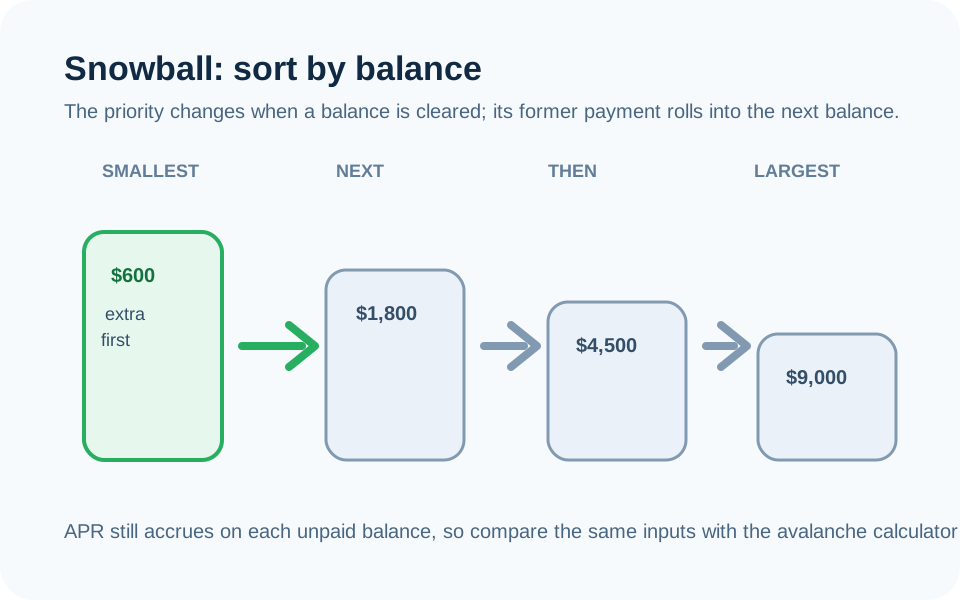
Consider balances of $600, $1,800, $4,500, and $9,000. Snowball sends the extra amount to $600 after minimums. When that debt is cleared, its minimum payment is not removed from the model; it becomes part of the amount available to attack the $1,800 balance. The attack payment can therefore grow even when the monthly budget is unchanged.
The page calculates interest each month as balance × APR ÷ 12 before applying payments. Its diagram shows why a fast first payoff does not erase interest on the other balances. Read the cumulative-interest comparison alongside the first-payoff date.
Compare snowball with avalanche honestly
Do not compare a snowball plan with an avalanche plan that uses a different monthly budget or a different debt list. Put the same current balances, APRs, minimum payments, and extra-payment timing into both. Then the remaining difference is the priority rule: smallest balance first versus highest APR first.
The calculator’s avalanche comparison makes that difference visible. You can also open the Debt Avalanche Calculator for the full highest-rate-first sequence and read the Snowball vs. Avalanche guide for a worked comparison. Neither strategy eliminates the need to meet real payment obligations.
A worked input check before you compare
Use current figures from each statement. For a sample check, enter a $600 balance at 24% APR with a $35 minimum and a $1,800 balance at 12% APR with a $60 minimum. A $200 total monthly debt budget leaves $105 after those minimums. In snowball mode, that $105 goes to the $600 balance in the first modeled month. In avalanche mode, it goes to the 24% balance as well in this two-debt example; use a larger lower-rate balance to see the orders separate.
The calculation is only as accurate as its entries. A $0 promotional rate that expires next month, a newly increased minimum, or a daily-interest account must be updated before you treat the timeline as useful.
Keep the plan connected to a real monthly budget
The page assumes the entire payment amount is available every month. It cannot decide whether that amount conflicts with housing, food, insurance, taxes, or other essential obligations. Use the Budget Calculator to account for recurring spending before treating an extra debt amount as stable.
If the entered monthly budget is below the combined minimums, the calculator uses the combined minimum figure because a regular payment sequence cannot model less than the stated minimums. That is a signal to review the real situation, not an answer to it. Contact the creditor or a suitable qualified resource for options when you cannot make required payments.
Use early milestones as information, not pressure
The first snowball payoff can be easy to notice because it is based on the smallest balance, but the model does not measure motivation, stress, income volatility, or the consequences of a missed payment. A quick milestone is therefore a scheduling feature, not proof that the approach is right for every situation. Compare the first payoff date with the modeled interest difference and the account terms you actually face.
Keep the total monthly debt budget fixed when you compare plans. If a snowball result looks better only because it uses more money than an avalanche comparison, the result is not a strategy comparison. Record any one-time payment separately and rerun both modes after it is applied so the next priority list reflects the remaining balances.