
Net Worth Calculator
Create a private balance-sheet snapshot by totaling the values you enter for assets and liabilities, then compare it carefully with dated household-survey context.
Asset Allocation
Asset Summary
| Item | Amount |
|---|
Liability Summary
| Item | Amount |
|---|
How This Is Calculated
Net worth is total assets minus total liabilities. Liquid net worth excludes home value, other real estate, vehicles, and other illiquid assets, then subtracts all debts. Age benchmarks use Federal Reserve Survey of Consumer Finances medians and averages.
Check the method before you use the estimate
This page documents the formula, assumptions, and any specific external sources used for this tool.
See the methodPlanning estimate What this result can and cannot tell you
This calculator is an educational balance-sheet snapshot, not financial advice, tax advice, legal advice, credit advice, investment advice, lending advice, valuation advice, or retirement advice. Verify values and seek qualified help for decisions involving assets or debts.
How the Net Worth Calculator works
These notes describe the calculation used on this page and the assumptions that can change a real-world result.
Total net worth = total entered assets - total entered liabilities. The calculator's liquid assets subtotal includes cash and savings, investments, and retirement accounts; liquid net worth = that subtotal - total entered liabilities.
Assumptions on this page
- Asset values and debt balances are supplied by the visitor. The page does not connect accounts, appraise property, verify balances, or determine whether an asset can be sold quickly.
- The liquid subtotal is a calculator category, not a guarantee of immediate cash availability. Retirement accounts, investments, restrictions, taxes, penalties, and market conditions can affect access and value.
- Age comparisons use rounded 2022 Federal Reserve Survey of Consumer Finances household figures; the survey population and date may not resemble an individual household.
Sources used on this page
- Federal Reserve: Survey of Consumer Finances 2022 report Used to check the 2022 household net-worth median and mean figures by age in Table 2, including the corrected age-75-and-over row.
- Federal Reserve: Survey of Consumer Finances Linked for the official survey's scope, releases, and data context; it does not provide a personal benchmark or recommendation.
Everything behind the Net Worth Calculator
Formulas, reference charts, and detailed answers — expand any section you need.
A net-worth number begins with a dated balance sheet
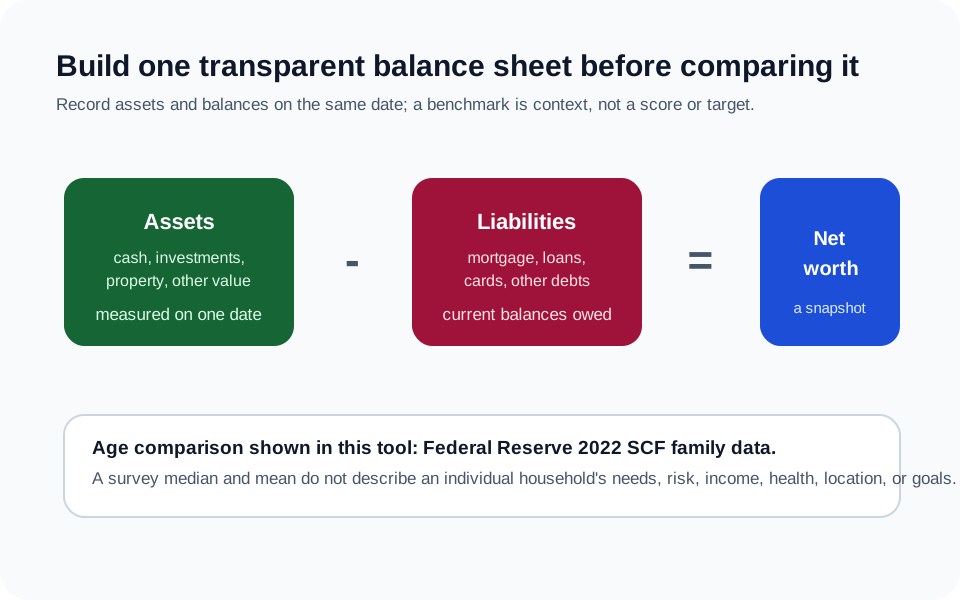
Net worth is the difference between what a balance sheet says you own and what it says you owe at one point in time. This page adds the values entered in its asset categories, adds the balances entered in its liability categories, and subtracts the second total from the first. It does not connect to an account, estimate a home value, identify a forgotten debt, or decide what an asset is worth. The value of the result depends on the care of the inputs.
Choose one snapshot date and use it consistently. A bank balance from today, a mortgage payoff figure from six months ago, and a car's original purchase price are not one coherent balance sheet. Record the source and date for material values so the next snapshot can be compared on equal terms. The Budget Calculator is useful for current cash flow; it answers a different question from a net-worth snapshot.
The basic arithmetic and a reproducible example
The formula is total assets minus total liabilities. Suppose the entered assets are $15,000 in cash and savings, $45,000 in investments, $80,000 in retirement accounts, and a $200,000 home value. Total assets equal $340,000. Suppose the entered liabilities are a $180,000 mortgage, $20,000 of student loans, and $10,000 of credit cards. Total liabilities equal $210,000. The resulting net-worth snapshot is $130,000.
The page also labels a separate liquid-assets subtotal. In this example it includes the calculator's cash, investment, and retirement categories: $140,000. After all $210,000 of liabilities are subtracted, the calculator's liquid net-worth figure is negative $70,000. That label does not mean retirement funds are penalty-free cash or that every investment can be sold immediately. It simply makes the category definition visible so it is not mistaken for a general liquidity test.
Value assets in a way you can explain later
Cash and stated account balances are usually easy to document. Market-traded investments change in value, while real estate, vehicles, collectibles, private businesses, and other assets need a reasonable dated valuation method. A home purchase price is not necessarily a current value, and a vehicle's original cost is not necessarily its resale value. If an amount is uncertain, use a range outside the calculator or write down the valuation source rather than presenting a precise-looking number as a fact.
Do not double count. For example, enter a retirement account in the retirement category and do not also add the same account to general investments. For property, decide whether the full estimated market value belongs in assets and the remaining loan balance belongs in liabilities; that method makes equity emerge naturally from the subtraction. The page does not assess taxes, transaction costs, jointly owned property, trusts, or restrictions on a particular asset.
Debt-to-asset ratio is descriptive only
The debt-to-asset ratio divides total entered liabilities by total entered assets. It can help describe the structure of one snapshot, but it does not measure monthly affordability, creditworthiness, interest cost, or the ability to make a payment. A household with the same ratio can have a very different situation depending on liquidity, income stability, loan terms, insurance, and the accuracy of asset values.
The explanatory text beside the ratio intentionally avoids calling a level good or bad. A ratio where liabilities exceed assets describes the entered balance sheet at that time; it is not a credit decision or a judgment about a person. For a payment-focused calculation, the Debt Payoff Calculator and Loan Calculator can be used with their own documented assumptions.
Read age comparisons as dated survey context
If an age is entered, the calculator displays rounded 2022 values from the Federal Reserve's Survey of Consumer Finances (SCF) by age of the survey reference person. The underlying Table 2 figures show a large gap between median and mean household net worth, which is why a mean should not be treated as a typical target. The tool labels the data year because it is historical survey context, not a current personal standard.
The calculator's rounded values include: under 35, $39,000 median and $183,000 mean; ages 35 to 44, $135,000 and $549,000; 45 to 54, $247,000 and $975,000; 55 to 64, $364,000 and $1.566 million; 65 to 74, $410,000 and $1.780 million; and age 75 and over, $335,600 and $1.6241 million. The age-75-and-over row is intentionally distinct from the 65-to-74 row. These figures reflect surveyed US families in 2022 dollars, not a rule for any individual.
A trend can be more useful than one comparison
Repeat the same balance-sheet process periodically with the same categories and valuation notes. Separating a market movement, debt repayment, new contribution, loan balance change, or changed property estimate is more useful than seeing one larger or smaller total. Save only the data you are comfortable retaining locally, and avoid sharing a detailed balance sheet through a public link.
A positive change can come from a higher asset estimate rather than additional cash, and a negative change can come from a market fluctuation rather than a change in spending. The page cannot identify the cause. Keeping a small change log beside each snapshot avoids drawing conclusions from a single number. For a stated savings contribution path, use the Savings Goal Calculator separately.
Privacy and correction reporting
A balance-sheet calculation can contain sensitive information even when it has no account connection. Enter rounded values if that is sufficient for planning, store data only where you understand the privacy consequences, and do not include account numbers, addresses, brokerage logins, tax records, or full statements in an issue report. The calculator needs only category totals to perform its arithmetic.
If the asset categories, survey citation, formula, output, or accessibility behavior appears wrong, use the page's Report an issue control. A report with a non-sensitive example and the observed result is enough to reproduce many problems. The correction route is for the tool and its public documentation; it cannot provide an appraisal, lending decision, or personalized debt strategy.