
Savings Goal Calculator
Estimate a savings-goal scenario from the target, current savings, recurring deposit, rate or APY, compounding, deposit timing, and deadline inputs you choose. The output is arithmetic under those assumptions, not a rate quote, product recommendation, or guarantee.
Example Goals
Emergency Fund
$15k • 2 yr
Down Payment
$60k • 4 yr
Car Fund
$25k • $400/mo
Vacation
$8k • 1 yr
Savings Plan View Results
Savings Summary
Deposits vs Interest
What-If Scenarios
Rate Sensitivity
| Rate | Months | Interest |
|---|
Month-by-Month Plan
| Month | Deposit | Interest | Balance |
|---|
How This Is Calculated
Future value with contributions uses FV = PV(1+r)n + PMT · [((1+r)n − 1) / r], with your own numbers plugged in:
Check the method before you use the estimate
This page documents the formula, assumptions, and any specific external sources used for this tool.
See the methodPlanning estimate What this result can and cannot tell you
Educational estimate only. This calculator does not quote an account rate, recommend a savings product, contribution, deadline, or goal priority, or provide financial, tax, legal, or investment advice. Confirm account terms and your actual cash flow before moving money. This is not financial advice.
How the Savings Goal Calculator works
These notes describe the calculation used on this page and the assumptions that can change a real-world result.
The page uses a future-value calculation with the entered current balance, periodic rate, number of periods, and recurring deposits: FV = PV(1 + r)^n + PMT × [((1 + r)^n − 1) ÷ r], with timing adjusted for start-of-period deposits. It can rearrange the scenario to solve for monthly deposit or time.
Assumptions on this page
- Target, current savings, monthly deposit, rate or APY, compounding frequency, deposit timing, and deadline are user-entered assumptions.
- The entered rate is treated as unchanged in the scenario. Actual account rates, APY, compounding, fees, minimums, balance tiers, and access terms can differ.
- The calculator does not verify account availability, deposit insurance, taxes, contribution limits, penalties, withdrawals, transfers, or whether a deadline is realistic for the household budget.
- Multiple-goal split modes are allocation math, not recommendations about priority, affordability, or which goal should be funded first.
Sources used on this page
- U.S. Securities and Exchange Commission: Investor.gov Free Financial Planning Tools Supports using separate savings-goal and compound-interest tools with explicit inputs; it does not endorse a contribution, rate, or investment choice.
- Consumer Financial Protection Bureau: Saving each payday Supports the basic planning task of calculating how long regular deposits may take to reach a goal; it does not set a personal savings target or rate.
Everything behind the Savings Goal Calculator
Formulas, reference charts, and detailed answers — expand any section you need.
A savings goal needs a defined cash target and date
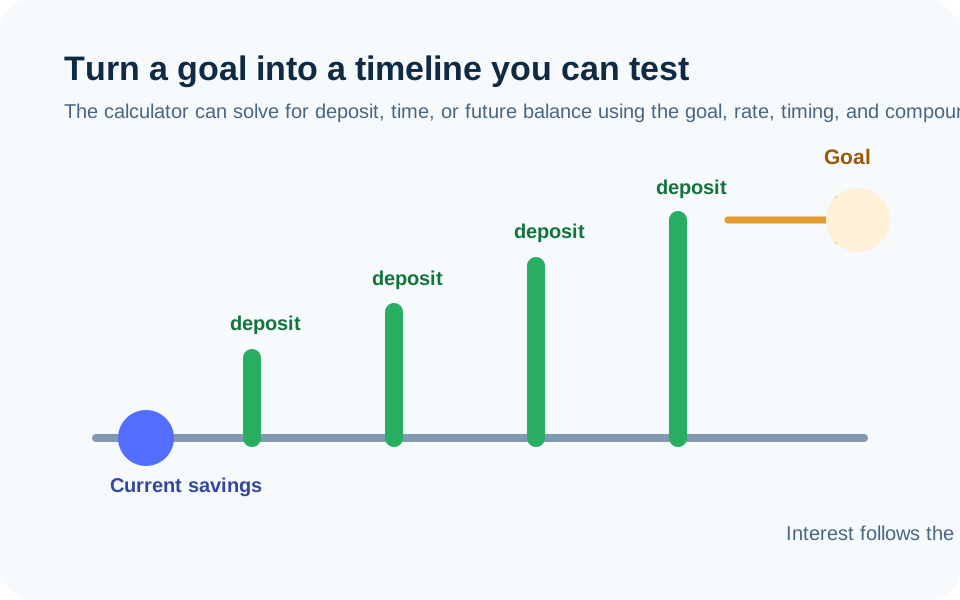
A useful savings scenario starts with a specific target amount, the balance already reserved for that goal, and a date or monthly deposit question. This page lets you solve different versions of the same arithmetic: how much to deposit each month, how long a selected deposit may take, or what balance the inputs produce by a date.
Do not merge unrelated goals just because the same account holds the money. A reserve for an unexpected expense, a future move, an annual insurance bill, and a discretionary purchase may have different access needs and deadlines. Separating them makes it clear which assumption is responsible for the result.
The math grows a current balance and recurring deposits
For a standard end-of-period deposit scenario, the future-value form combines the current balance with the stream of deposits: FV = PV(1 + r)n + PMT × [((1 + r)n − 1) ÷ r]. The calculator uses the periodic rate and selected compounding frequency, then adjusts the timing when deposits are made at the start of a period.
For example, with a $1,000 current balance, no interest, a $250 monthly deposit, and a $4,000 target, the simple cash arithmetic requires $3,000 more, or 12 deposits. An entered rate can change the modeled timeline, but it does not guarantee that the rate, deposit, or account access will remain the same.
Rate, APY, and deposit timing are not minor details
The rate or APY field matters because it changes the assumed periodic growth. The compounding choice matters because it determines how the annual input is divided and applied. The deposit timing matters because a start-of-period contribution is exposed to the model’s growth for longer than an end-of-period contribution.
Use the label and terms that actually appear in the account disclosure. Do not enter a headline rate from an advertisement and assume it applies to your balance, term, location, account type, or future period. Verify fees, balance tiers, withdrawal rules, and rate changes with the account provider.
Use multiple-goal mode to make trade-offs visible
Multiple-goal mode divides the total monthly savings budget by the priority or proportional method you choose. That is allocation arithmetic. A priority split sends available money to the selected first goal before later goals; a proportional split gives each goal a share. The calculator does not decide which goal deserves priority or whether the overall monthly amount fits your budget.
For a cash-flow check, use the Budget Calculator with the same monthly contribution. For an emergency-reserve definition, use the Emergency Fund Calculator. Keeping the inputs consistent across tools is more useful than relying on a generic percentage rule.
Interpret a goal date as a condition, not a promise
A “goal reached” month means the modeled balance has met the target under the inputs shown. It does not mean a transfer will happen on schedule, an account will credit the same rate, or the target will remain enough when the time arrives. Rerun the scenario after a changed rate, missed deposit, withdrawal, updated price, or new deadline.
The Compound Interest Calculator can help inspect the underlying growth math, while the Investment Calculator is for a broader risk-and-return scenario. A cash-savings deadline and an investment projection should not be treated as the same type of plan.
Turn the result into a calendar of deposits
After choosing a monthly amount, note the first deposit date, the expected recurring date, and the source of the cash. A monthly amount that looks possible in an annual average may be difficult in a particular paycheck cycle. Matching the deposit schedule to actual pay timing makes the scenario easier to inspect and lets you notice a missed transfer before it becomes a larger gap.
Recalculate when the target price changes. A travel, repair, move, tax, education, or purchase goal can rise or fall before the deadline, and a prior target may no longer be sufficient. The calculator does not automatically update a price or rate. Treat each rerun as a dated scenario and keep the underlying target source separate from the arithmetic.