
Simple Interest Calculator
Calculate simple interest or solve for principal, annual rate, time, or final amount from the inputs you enter. The page converts time to years for I = P × r × t and shows a separate monthly-compounding comparison; it is not a loan disclosure or rate quote.
Loan / Savings Details View Results
Simple vs Compound Comparison
Interest: –
Interest: –
Step-by-Step Worked Solution
How This Is Calculated
Simple interest uses I = P × R × T where R is the annual rate as a decimal and T is time in years. Rearrangements: P = I ÷ (R × T), R = I ÷ (P × T), T = I ÷ (P × R). Compound comparison uses monthly compounding: A = P(1 + r/12)12t.
Check the method before you use the estimate
This page documents the formula, assumptions, and any specific external sources used for this tool.
See the methodPlanning estimate What this result can and cannot tell you
Educational calculation only. This page is not a loan disclosure, payoff quote, rate quote, account statement, or financial, tax, legal, or investment advice. Confirm the actual agreement’s rate, day-count, compounding, fees, and payment terms with the provider. This is not financial advice.
How the Simple Interest Calculator works
These notes describe the calculation used on this page and the assumptions that can change a real-world result.
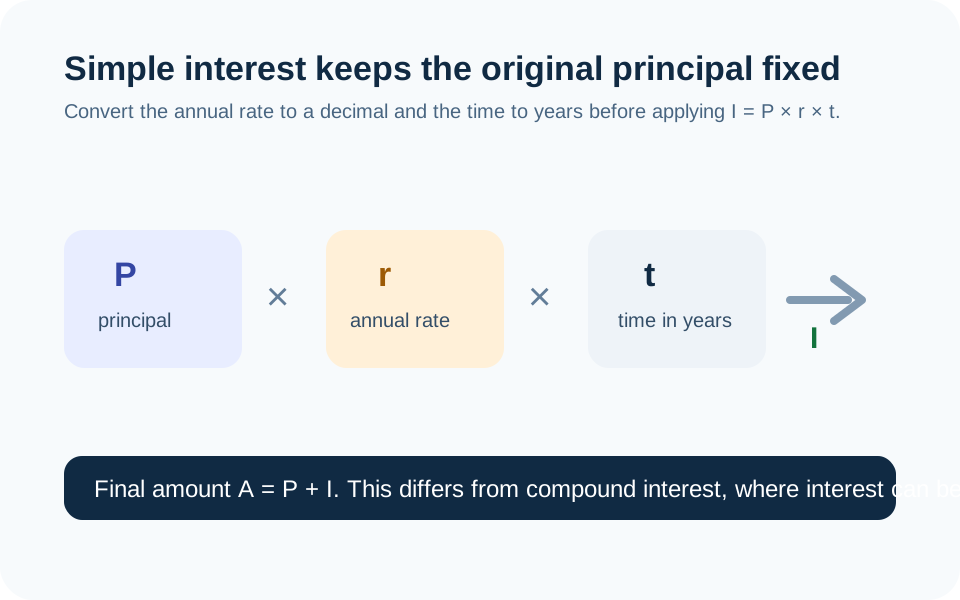
Simple interest is I = P × r × t, where P is principal, r is annual rate as a decimal, and t is time in years. Final amount is A = P + I. The calculator rearranges the same equation to solve for P, r, or t and converts months or days to a years input.
Assumptions on this page
- Principal, interest, annual rate, time, time unit, and the variable to solve are user-entered values.
- The rate is treated as a fixed annual simple rate and the time is converted to a year fraction according to the selected unit. Actual agreements may use a different day-count convention, periodic rate, compounding method, or payment schedule.
- The compound comparison uses monthly compounding as stated on the page; it is a mathematical contrast, not a representation of a specific account or loan.
- The calculator excludes fees, taxes, penalties, changing rates, deposits, withdrawals, loan amortization, payment due dates, and contract-specific terms.
Sources used on this page
- U.S. Securities and Exchange Commission: Investor.gov Compound Interest Calculator Supports distinguishing an explicit rate, time, contribution, and compounding assumption in a growth scenario; this page uses it only as context for the simple-versus-compound comparison.
Everything behind the Simple Interest Calculator
Formulas, reference charts, and detailed answers — expand any section you need.
Simple interest uses one principal base
Simple interest is the direct formula I = P × r × t. P is the principal amount, r is the annual rate written as a decimal, and t is time in years. The key feature is that the formula applies the rate to the original principal. It does not add prior interest to the base for a later period.
The page can also solve the same equation backward for principal, rate, or time. That makes it useful for checking arithmetic, but it does not identify the calculation method in a loan or deposit contract. Read the provider’s disclosure before assuming a real product uses this formula.
Convert units before you multiply
The annual rate must be written as a decimal and time must be expressed in years. A 6% annual rate becomes 0.06. Eighteen months becomes 1.5 years. If you enter $5,000 at 6% for 18 months, the simple-interest result is $5,000 × 0.06 × 1.5 = $450, and the final amount is $5,450 before any fees, payments, or contract-specific adjustments.
That unit conversion is where many apparent formula errors originate. A numeric “6” is not 6% as a decimal; 18 months is not 18 years. The calculator’s selected months or days option handles a stated conversion, but an actual agreement may use a specific day-count convention that differs from a simple calendar approximation.
Solving for the unknown uses the same relationship
When interest is known, the page rearranges the formula rather than choosing a new method: principal is I ÷ (r × t), rate is I ÷ (P × t), and time is I ÷ (P × r). Each rearrangement still depends on consistent units. If the rate is annual, time must be a fraction of a year.
For example, if $450 of simple interest is known on $5,000 over 1.5 years, the implied annual rate is $450 ÷ ($5,000 × 1.5) = 0.06, or 6%. That is an arithmetic check. It does not prove a lender calculated an account correctly if the real agreement includes fees, changing rates, payments, or another interest method.
The compound comparison answers a different math question
The comparison panel uses monthly compound growth, A = P(1 + r/12)12t, to show why a fixed simple-interest assumption can differ from a compounding assumption at the same stated annual rate and time. It is not a quote for a certificate, savings account, card, or loan. Products can compound on different schedules or use daily balances, minimum payments, fees, and changing rates.
Use the Compound Interest Calculator when you want to inspect compounding frequency, contribution timing, and recurring deposits in more detail. Use the Loan Calculator for a payment schedule instead of treating a loan as a simple-interest balance unless the contract states that method.
What a formula result cannot settle
The page cannot determine the applicable APR, annual percentage yield, payment allocation, day-count basis, late fee, prepayment rule, tax treatment, or whether a rate is fixed or variable. A lender or account provider’s disclosure controls those terms. Entering a rate into a calculator does not turn it into a verified current fact.
Keep a record of the values used: the stated principal, rate label, dates, time unit, and source document. If a simple unit conversion or formula output appears wrong, report the issue with a non-sensitive example. Do not include account numbers, full statements, or personal data.
Dates can matter more than rounded years
If a contract uses specific calendar dates or a stated day-count convention, do not replace it casually with a rough number of months or days. This page converts a selected unit to a years input for a transparent mathematical check, but an actual statement may count days differently or apply interest before or after payments. Use the exact contract method when a small difference matters.
Keep the rate source with the calculation. Write down whether the percentage is a stated annual rate, an APR, a promotional rate, or an effective annual yield. These labels can imply different calculation methods. The simple formula remains useful for learning and checking an assumption, but it cannot settle a dispute about product-specific terms.