
CD Calculator
Calculate a certificate-of-deposit maturity scenario from the deposit, stated rate or APY, compounding, term, and optional early-withdrawal inputs you enter. Compare the arithmetic with the issuing institution’s current disclosure before opening, renewing, or breaking a CD.
CD Details View Results
Term Comparison (APY per term)
| Term | APY (%) | Maturity | Interest |
|---|
Month-by-Month Growth
| Month | Interest | Balance |
|---|
How This Is Calculated
CD maturity uses A = P(1 + r/n)nt with your exact term in months. APY and nominal rate convert both ways at your compounding frequency. Early withdrawal penalties forfeit X months of simple interest on the deposit.
Check the method before you use the estimate
This page documents the formula, assumptions, and any specific external sources used for this tool.
See the methodPlanning estimate What this result can and cannot tell you
Educational estimate only. This calculator is not a CD quote, account recommendation, deposit-insurance determination, or financial advice. Confirm the current product disclosure, issuer status, APY or rate, compounding, maturity, renewal, access, and early-withdrawal terms with the issuing institution before moving money. This is not financial advice.
How the CD Calculator works
These notes describe the calculation used on this page and the assumptions that can change a real-world result.
For a nominal annual rate, maturity value = principal × (1 + r/n)^(n×t), using the selected compounding frequency and term. When APY is entered, the calculator converts it to the corresponding nominal periodic rate for the selected frequency. The early-withdrawal scenario forfeits the entered number of months of simple interest on principal.
Assumptions on this page
- Deposit, rate label, APY or nominal rate, compounding frequency, term, start date, withdrawal date, and penalty months are user-entered scenario values.
- The early-withdrawal calculation is a simplified penalty scenario and is not the issuer’s contract. Actual penalties can use different formulas, accrued interest, principal, rate changes, bonuses, or account-specific conditions.
- The calculator does not verify issuer insurance status, rate availability, tiered balances, callable or market-linked features, renewal rules, grace periods, taxes, fees, or product eligibility.
- A maturity projection is not a quote, recommendation, or assurance that the product will remain available on those terms.
Sources used on this page
- Consumer Financial Protection Bureau: What is a certificate of deposit (CD)? Supports checking a CD’s term, interest rate, and early-withdrawal penalty when comparing offers; it does not supply a rate for this calculator.
- Federal Deposit Insurance Corporation: Shopping for a Certificate of Deposit Supports reviewing issuer status, rate type, maturity, renewal, early-redemption terms, and product features before buying a CD.
Everything behind the CD Calculator
Formulas, reference charts, and detailed answers — expand any section you need.
A CD result should start with the issuer’s current disclosure
A certificate of deposit has a stated term and rate arrangement, but the labels matter. This calculator asks whether you are entering APY or a nominal annual rate, the compounding frequency, the deposit amount, and the term. It uses those inputs to estimate a maturity value. The result is useful only when the inputs match the disclosure for the specific product you are considering.
The Consumer Financial Protection Bureau advises comparing the term, rate, and early-withdrawal penalty when shopping for a CD. The Federal Deposit Insurance Corporation also highlights issuer status, renewal, rate type, and product features. None of those facts are fetched by this calculator, so check them outside the page.
How the maturity calculation works
For a nominal annual rate, the model uses A = P(1 + r/n)nt: P is principal, r is the rate as a decimal, n is the selected compounding periods per year, and t is the term in years. If you enter APY instead, the page converts it to the corresponding nominal periodic rate for the selected frequency before building the month-by-month path.
For example, a $10,000 deposit at a 5% nominal rate compounded monthly for one year is modeled as $10,000 × (1 + 0.05/12)12, or about $10,511.62 before any taxes or product-specific adjustments. A product with a 5% APY may use a different nominal-rate input, so do not mix the labels.
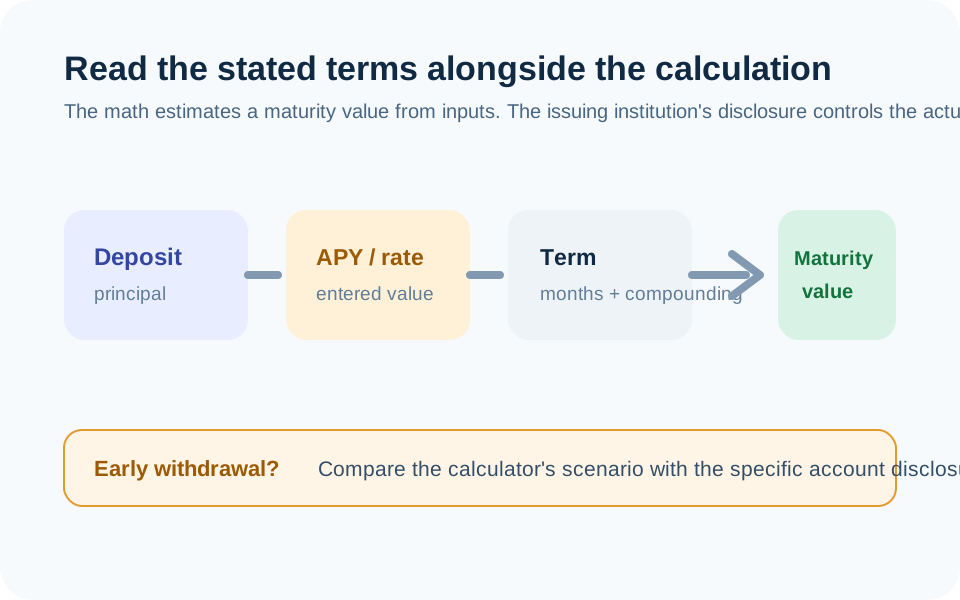
An early-withdrawal number is a scenario, not a penalty quote
The early-withdrawal panel treats the penalty you enter as a number of months of simple interest on principal. That is deliberately a simplified check. An actual CD agreement may calculate an early redemption differently, reduce accrued interest, affect principal in unusual cases, change terms after a withdrawal, restrict withdrawals entirely, or include a grace-period and renewal rule.
Read the product disclosure directly before acting. The FDIC’s CD shopping guidance is included because it emphasizes these product features—not because this page can determine whether breaking or renewing a CD is appropriate.
A ladder is a schedule of separate terms
In ladder mode, the total amount you enter is split evenly across the number of rungs, and the calculator produces separate maturity scenarios for the selected terms. That creates a schedule for inspection; it does not assure liquidity, a renewal rate, or an available product at a future date.
Review each rung’s issuer, deposit-insurance coverage, rate type, maturity, renewal rule, and early-access terms independently. A later rung may be offered at a different rate, and a brokered, callable, variable, or market-linked product can behave differently from a plain fixed-rate bank CD.
Keep the access question separate from the yield question
A higher modeled maturity value does not answer whether a term fits a particular cash need. If money may be needed before maturity, model the stated penalty but also check whether early access is allowed and what the issuer’s rules say. The Emergency Fund Calculator is a separate cash-coverage scenario; it cannot decide whether a particular CD is suitable for accessible reserve money.
For pure growth arithmetic without product terms, use the Compound Interest Calculator. The two tools should not be treated as interchangeable: a CD calculation needs the actual disclosure, while a generic compound-growth scenario does not represent a specific account.
Use a disclosure checklist before relying on a maturity figure
For each CD scenario, record the issuing institution, the exact account name, rate label, APY or nominal rate, compounding frequency, term, minimum balance, maturity date, automatic-renewal rule, grace period, and early-withdrawal policy. A generic term length and a headline rate are not enough to identify the product calculation. If the product has a variable, callable, market-linked, brokered, or promotional feature, read the relevant terms in full.
Do not assume that one account’s early-withdrawal rule applies to another. The calculator’s penalty field helps test a disclosed formula, but it cannot decide whether the stated penalty applies to your deposit date, balance, or circumstance. Confirm the scenario with the issuer before opening, funding, redeeming, or rolling a deposit.