
How Much Concrete Do I Need for a Slab?
Measure a slab, calculate its net volume, state an ordering allowance, and check the ready-mix or bagged-product information before ordering.
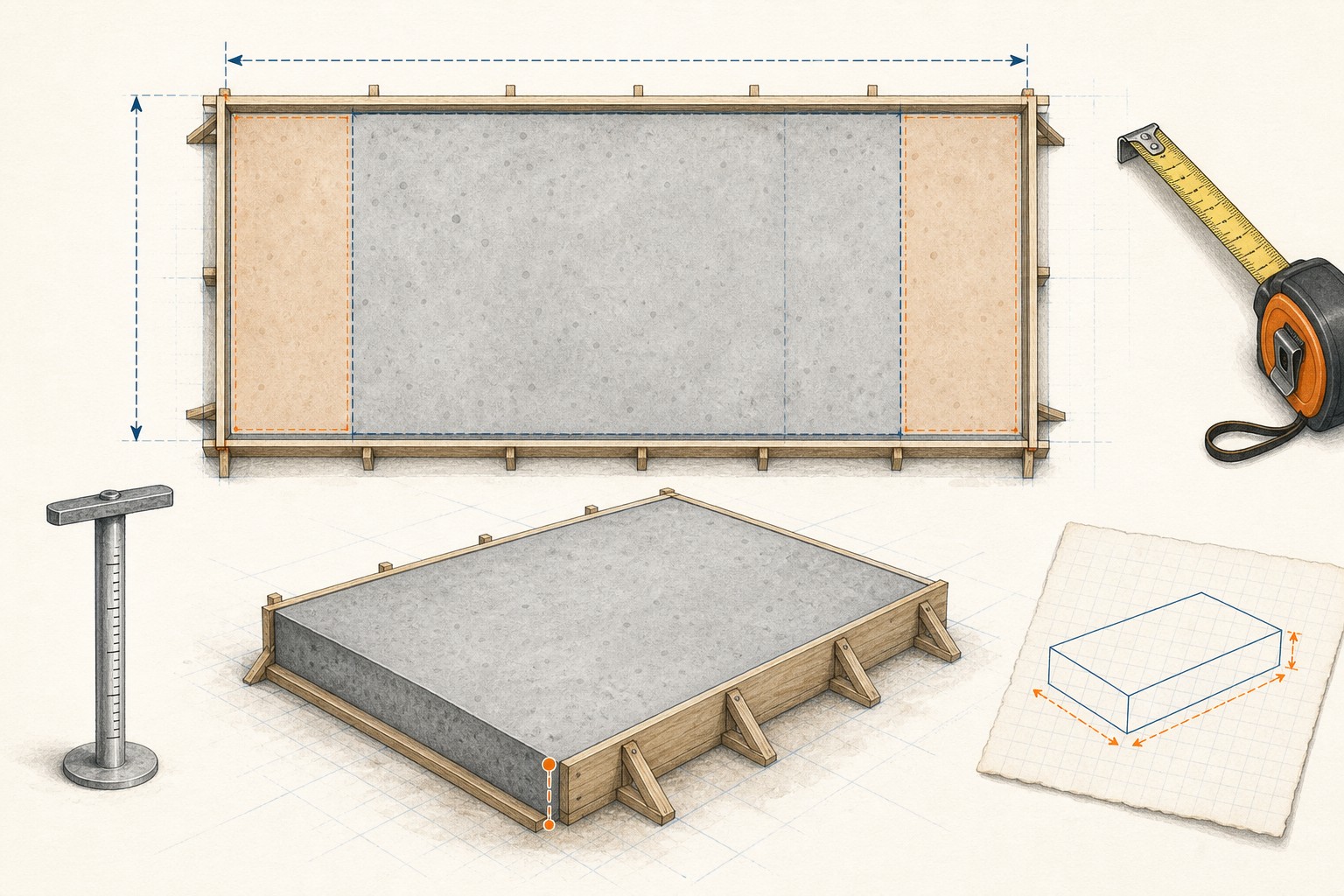
A concrete quantity estimate has two separate jobs: calculate the net geometric volume of the forms, then decide what quantity to order after checking the site, the mix, and the supplier's ordering rules. Keeping those jobs separate is more useful than treating a default waste percentage as a design rule. Our Concrete Calculator follows the same volume math and shows its assumptions so you can change them.
This guide estimates quantity, not slab design. Thickness, reinforcement, joints, subbase, drainage, strength, permits, and placement method must be selected for the actual project and local requirements. Ask the ready-mix producer and the authority having jurisdiction when those decisions affect the work.
Start with finished dimensions, not a rough site sketch
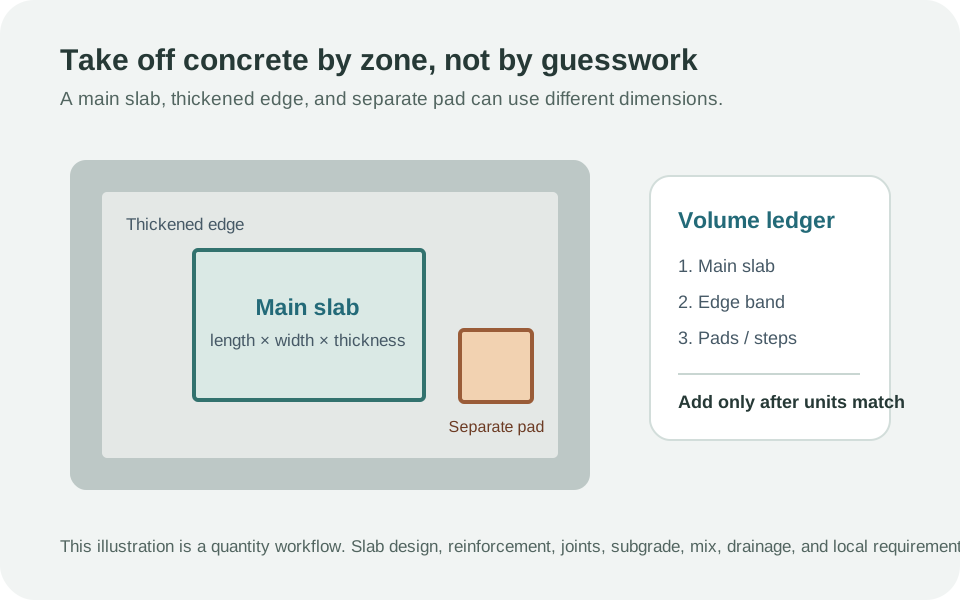
Measure the inside dimensions of the forms or the finished slab footprint. Record each zone separately when the slab has a thickened edge, a step, a footing, a curb, or a different thickness. Do not average those areas into one depth unless the shape really is uniform. A short takeoff sheet is more reliable than one memory-based total:
| Zone | Length | Width | Specified thickness | Net volume |
|---|---|---|---|---|
| Main rectangle | 10 ft | 10 ft | 4 in | 33.33 ft³ |
| Separate thickened strip | Record separately | Record separately | Record separately | Add only if specified |
The volume formula
For one rectangular zone, convert thickness to feet before multiplying. Then divide cubic feet by 27 to convert to cubic yards.
The 27 ft³ per yd³ conversion is exact. The dimensions are only as accurate as the measurement and the finished elevation used for the takeoff.
Worked example: a 10 × 10 ft slab at 4 in
Assume a simple rectangular slab with no thickened perimeter and a specified thickness of 4 inches.
- Convert thickness: 4 ÷ 12 = 0.3333 ft.
- Find net volume: 10 × 10 × 0.3333 = 33.33 ft³.
- Convert to yards: 33.33 ÷ 27 = 1.234 yd³.
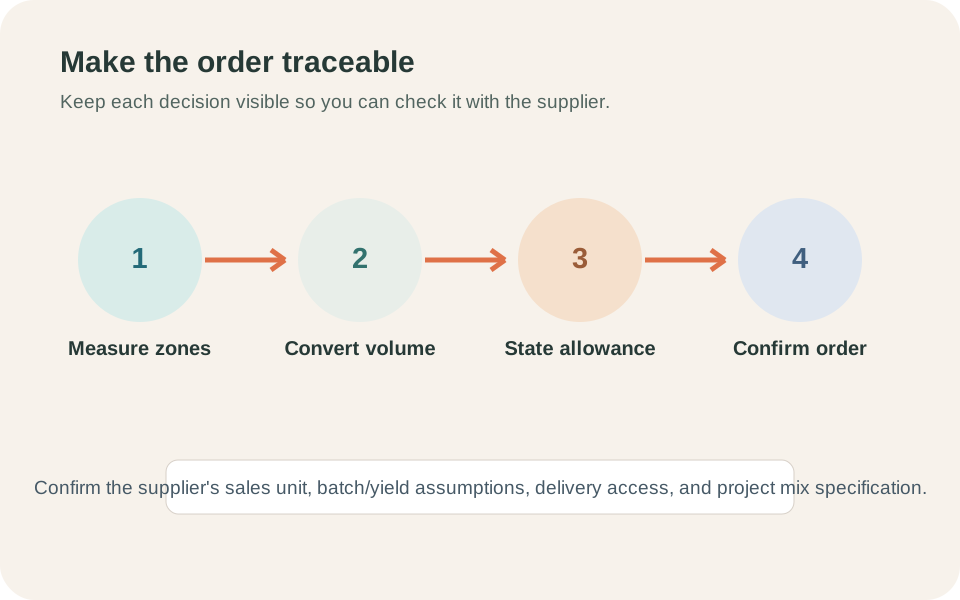
If the ordering allowance chosen after the site check is 7%, the planning quantity is 1.234 × 1.07 = 1.320 yd³. That is an example assumption, not an instruction to order a particular truck quantity. Ask the producer how it rounds orders, whether a short-load charge applies, and what minimum quantity it can deliver.
Why the order quantity can differ from the net takeoff
Forms can bow, excavation can be deeper than planned, and a placement can include small features that were missed on a drawing. NRMCA notes that an order allowance is often needed, but the suitable amount depends on the job. Document the reason for any allowance rather than using the same percentage for every project.
- Uniform forms and verified elevations: the net takeoff may need only a small, stated allowance.
- Irregular excavation or multiple transitions: measure the extra zones instead of hiding them in a large generic allowance.
- Hand-mixed bags: use the yield printed for the exact bag and product; package size alone does not establish yield.
- Ready mix: confirm order increments, access, placement rate, washout, and the mix designation with the producer.
Bagged mix versus ready-mix: compare like with like
Both choices begin with the same net cubic-foot calculation. The next step is different: bagged products publish a yield on the package or technical data sheet, while ready-mix is normally quoted by volume. Do not reuse a bag yield from a different product, and do not assume every mixer truck carries the same quantity.
For a bagged-product planning check, use:
Round only after you know the retailer's package size and whether the calculation includes an allowance. For ready mix, send the producer the measured quantity and describe the placement. NRMCA's ordering guidance also highlights site access: a loaded mixer is heavy and may not be able to use loose soil, curbs, or narrow paths.
A practical order-check list
- List every separately measured zone and retain the unrounded net total.
- State the allowance and why it is included.
- Confirm the specified mix, exposure requirements, and any engineering or permit requirements with the responsible professional or local authority.
- Ask the producer about order increment, minimum load, delivery timing, truck access, and discharge/placement limitations.
- Compare the delivery ticket to the ordered mix and quantity before placement, then keep the ticket with the project record.
Verification pass: test the thickness input
Use a second calculation to check the order of magnitude before placing an order. In the 10 ft by 10 ft example, a 4 in thickness produces 33.33 ft³ or 1.234 yd³. If the measured or specified thickness were 4.5 in instead, the same footprint would produce 10 × 10 × (4.5 ÷ 12) = 37.5 ft³, or 1.389 yd³. The extra half-inch changes net volume by 0.155 yd³ before any allowance. That is why the thickness should come from the actual plan or verified forms, not a remembered default.
Before calling the supplier, recheck all three inputs: dimensions inside the forms, thickness at the governing finished elevation, and separately measured thickened zones. If the arithmetic differs from a drawing or quote, resolve the measurement first. Rounding a questionable total does not make it more reliable.
Decision point: where quantity math stops
The calculator can total volume, but it cannot decide whether a slab is suitable for vehicle loads, frost conditions, expansive soil, drainage, reinforcement, or a particular building connection. Do not increase thickness or add material as a substitute for a structural or site decision. When a plan, permit, engineer, or producer specifies a mix or placement requirement, record that direction separately from the volume estimate and order only after the responsibilities are clear.
Make the quote comparable
When you request a concrete quote, keep the volume calculation separate from the product and placement decisions. Record the measured volume, the stated allowance, the selected supplier product, the quote date, and any delivery or placement terms that affect the order. If the supplier asks for a different strength, exposure, finish, or placement method, that is a specification question for the responsible project party; it is not a reason to silently change the volume calculation. A clear record lets you compare quotes without claiming that every mix or slab condition is interchangeable.
Use the calculator, then verify the project inputs
The Concrete Calculator can total common shapes and make the unit conversions repeatable. Use the Cubic Yard Calculator when you need to keep several volume zones in a simple takeoff. These are planning tools; they do not approve a structural slab or replace supplier, engineering, safety, or local-code decisions.
Sources and assumptions
These links support the specific material, product, or reference points used in this guide. Local conditions and supplier specifications can still vary.
- NIST Handbook 44, Appendix C: General Tables of Units of Measurement Supports the exact U.S. customary conversion used here: 27 cubic feet equals 1 cubic yard.
- NRMCA CIP 31: Ordering Ready Mixed Concrete Explains that ready-mix is ordered by volume, that an allowance is project-specific, and that access and placement details belong in the supplier order.
- NRMCA TIP 8: Concrete Yield Provides context for actual delivered yield and the reasons a measured placement can differ from a simple geometric takeoff.
- ACI 318 Building Code Portal Identifies ACI 318 as a structural concrete design resource; quantity arithmetic does not replace structural design and detailing.
- 2024 International Residential Code: Referenced Standards Shows the code's referenced concrete standards; the locally adopted edition and amendments control a particular project.