Fill Dirt Calculator
Estimate exactly how much fill dirt you need for grading, leveling, excavation, foundation preparation, landscaping, and construction projects. Instantly calculate yards, tonnage, loads, and costs.
Example Projects
Configure Project View Results
For Yard Leveling, a depth of 4 to 6 inches is typical. Light to Medium compaction is recommended to prevent settling under lawn.
Quantity Estimates
View Calculation Breakdown
Detailed Measurements Live
| Loose Volume (To Order) | 0.0 yd³ |
| Compacted Volume (Geometric) | 0.0 yd³ |
| Compaction Adjustment | +10% Volume added |
| Loose Volume (Cubic Feet) | 0.0 ft³ |
| Loose Volume (Cubic Meters) | 0.0 m³ |
| Total Material Weight | 0.0 tons |
| Soil Density | 2,400 lbs/yd³ |
| Small Truckloads (~7.5 yd³) | 0.0 loads |
| Standard Truckloads (~12 yd³) | 0.0 loads |
| Large Truckloads (~18 yd³) | 0.0 loads |
How this was calculated:
Everything behind the Fill Dirt Calculator
Formulas, reference charts, and detailed answers — expand any section you need.
Fill Dirt Coverage Chart
Use this quick reference to see how much area 1 cubic yard (CY) of fill dirt covers at different depths:
| Layer Depth | Coverage Area per Cubic Yard |
|---|---|
| 1 inch | 324 sq ft |
| 2 inches | 162 sq ft |
| 3 inches | 108 sq ft |
| 4 inches | 81 sq ft |
| 6 inches | 54 sq ft |
| 12 inches (1 foot) | 27 sq ft |
How to Use the Fill Dirt Calculator
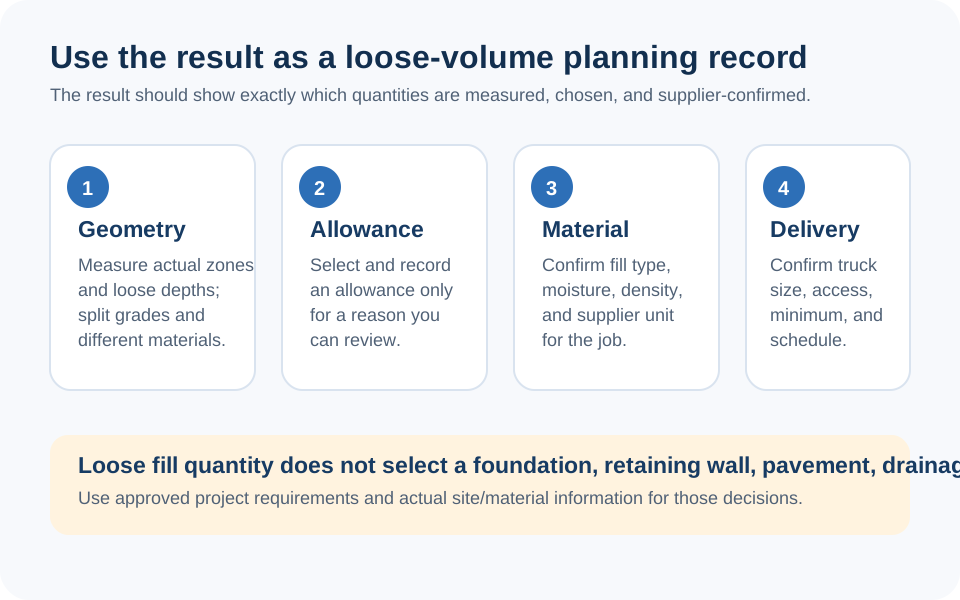
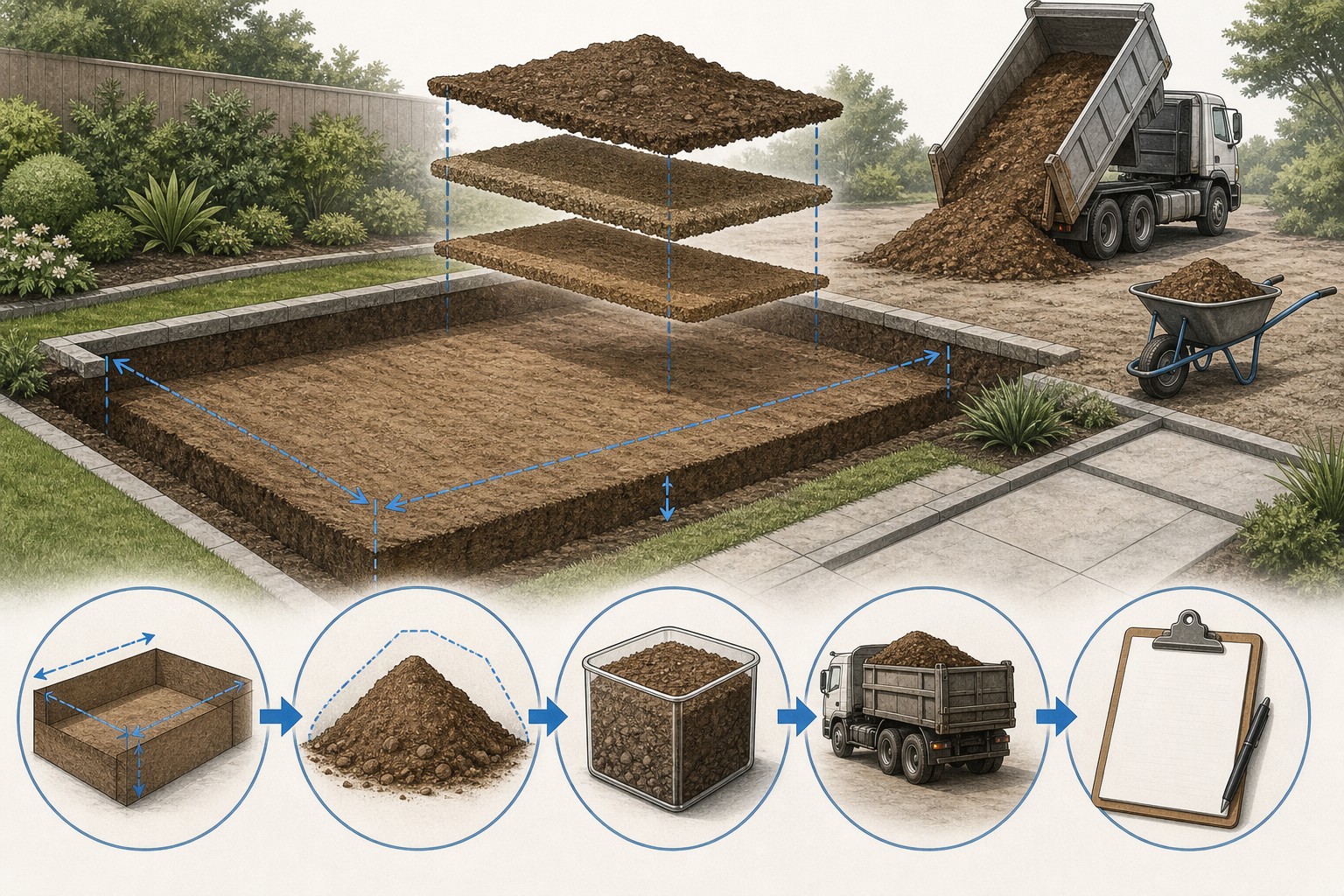
Using the Fill Dirt Calculator is simple. Enter your project dimensions, select the fill type, choose the compaction level, and optionally enter material pricing. The calculator instantly estimates cubic yards, tons, truckloads, and cost. This helps avoid under-ordering or over-ordering fill material.
What Is Fill Dirt?
Fill dirt is clean subsoil used to raise, level, or stabilize land. Unlike topsoil, fill dirt contains very little organic material. Common uses include grading, foundation support, building pads, and backfill projects.
Since it doesn't decay or compress over time like organic soils, it is highly valued as a base layout material in major engineering and earthmoving operations.
Fill Dirt Volume Formula
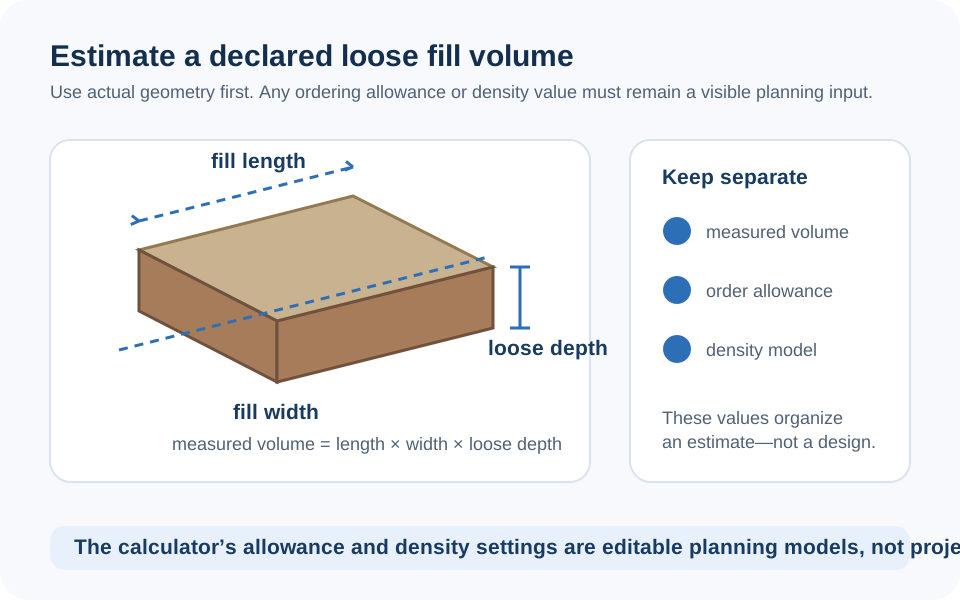
Volume is calculated using length, width, and average depth:
The calculator converts measurements into cubic yards, the standard unit used by most bulk soil suppliers.
Fill Dirt Weight Formula
Weight depends on soil type, composition, and moisture content. Typical loose fill dirt weighs:
- Standard Fill Dirt: ~2,400 lbs per cubic yard (1.2 tons/CY)
- Clay Fill: ~2,700 lbs per cubic yard (1.35 tons/CY)
- Sandy Fill: ~2,600 lbs per cubic yard (1.3 tons/CY)
- Structural Fill: ~3,000 lbs per cubic yard (1.5 tons/CY)
- Mixed Fill: ~2,500 lbs per cubic yard (1.25 tons/CY)
The calculator automatically estimates total tonnage requirements so you can calculate shipping constraints.
Fill Dirt Calculator for Yard Leveling
Many homeowners use fill dirt to correct low spots, uneven lawns, and drainage issues. This calculator helps determine the correct amount needed. When leveling a yard, you should clear any heavy turf first, pour the fill subsoil, and compact it lightly before layering topsoil for seed or sod.
Fill Dirt Calculator for Building Pads
Construction projects often require compacted fill beneath structures. Slabs, driveways, garages, workshops, and houses must be built on dense foundation pads. Estimating structural fill and applying a 15% compaction factor ensures your pad matches the geometric engineers specifications without settling later.
Fill Dirt Calculator for Backfill
Backfill is soil returned to a trench or hole after excavation work is completed. It is commonly used around concrete foundations, utility pipe lines, trenches, and retaining walls. The calculator helps contractors budget backfill needs.
Compaction Explained
Compaction significantly affects soil volume requirements. Loose dirt contains air pockets. When rolled, pressed, or tamped, soil particles compress, shrinking the volume. Most competitors ignore compaction completely, leading to soil shortage.
Typical compaction shrinkage values:
- Light Compaction (5%): Used for garden path backfills and minor low spots.
- Medium Compaction (10%): Standard yard grading, lawns, and drainage fills.
- Heavy Compaction (15%): Structural building pads, driveway subbases, and wall backfills.
Dump Truck Capacity Guide
Soil yards are typically delivered in dump trucks. Knowing capacity matches orders to truckload quantities:
- Small Utility Dump Truck: 5 to 10 Cubic Yards capacity.
- Standard Commercial Dump Truck: 10 to 16 Cubic Yards capacity.
- Large Tri-Axle Dump Truck: 16 to 20 Cubic Yards capacity.
Fill Dirt Cost Estimator
Clean subsoil fill is generally inexpensive, ranging from $5 to $30 per cubic yard. However, total project pricing is heavily influenced by:
- Delivery distances: Soil is heavy, meaning fuel and trucking logistics represent the largest cost component.
- Soil Quality: Certified structural fill tested for plastic limits costs more than simple unscreened excavation soil.
- Local availability: Areas with high clay or rock content may experience supply margins.
Common Fill Dirt Project Examples
- Low Spot Repair: A 20 ft × 20 ft yard depression filled at 4 inches depth needs ~5.4 yards.
- Yard Regrading: A 50 ft × 40 ft uneven lawn filled at 6 inches requires ~40.7 yards (with 10% compaction factor).
- Foundation Backfill: A 40 ft × 4 ft trench filled 4 feet deep needs ~26 yards.
- Building Pad: A 30 ft × 40 ft slab prep filled 12 inches deep needs ~51.1 yards (compaction factor 15%).
Frequently Asked Questions
How much fill dirt do I need?
The amount depends on project dimensions and fill depth. This calculator automatically estimates the required volume. Simply measure length, width, and depth, and the tool outputs loose cubic yards to order.
How much does fill dirt weigh?
Most standard fill dirt weighs between 2,000 and 3,000 pounds per cubic yard (approx. 1.0 to 1.5 tons) depending on composition and moisture. Sandy or dry soil is lighter, while wet clay or rocky structural fill is heavier.
How much does fill dirt cost?
Typical prices range from $5 to $30 per cubic yard before delivery. Unscreened fill can sometimes be sourced for free from construction excavations, but delivery fees will still apply.
What is the difference between fill dirt and topsoil?
Fill dirt is subsoil with little organic matter, making it stable and resistant to decomposing, which is ideal for grading or foundations. Topsoil contains nutrients and organic material, perfect for growing lawns, trees, and gardens.
How many cubic yards fit in a dump truck?
Most standard dump trucks carry between 10 and 16 cubic yards. Smaller utility trucks carry 5 to 10 yards, while large commercial triple-axle trucks can transport up to 20 cubic yards.
Should fill dirt be compacted?
Yes. Compaction improves stability and reduces future settling. Uncompacted soil will sink significantly after rain, leaving hollow spots.
Can I use fill dirt for a foundation?
Yes. Structural fill (specifically certified sand-clay mixtures) is commonly compacted beneath foundations and building pads to create a load-bearing surface.
Can I use this calculator for backfill?
Yes. It works for foundations, retaining walls, utility trenches, and general excavation backfill grading projects.