Cement Calculator
Estimate cement bags, sand, aggregate, and water for concrete, plastering, or mortar mixes. Enter dimensions and a mix ratio and the calculator handles the dry-volume factor and ratio split for you — plus total material cost.
Example Projects
Concrete Slab
20 × 15 ft • 4 in • 1:2:4
Footing / Beam
30 ft × 18 in • 1:1.5:3
Wall Plastering
30 × 10 ft • 12 mm • 1:6
Brick Mortar
20 × 10 ft wall • 1:6
Configure Mix View Results
Material Estimate
View Calculation Breakdown
| Wet volume | 0 m³ |
| Dry-volume factor | × 1.54 |
| Dry volume | 0 m³ |
| Mix ratio | 1:2:4 |
| Cement volume | 0 m³ |
| Cement weight | 0 kg |
| Cement bags | 0 bags |
| Sand volume | 0 m³ |
| Sand weight | 0 kg |
| Aggregate volume | 0 m³ |
| Aggregate weight | 0 kg |
| Water | 0 L |
How this was calculated:
Everything behind the Cement Calculator
Formulas, reference charts, and detailed answers — expand any section you need.
Concrete Mix Ratio Guide (1:1.5:3, 1:2:4, 1:3:6)
Mix ratio is expressed as cement to sand to aggregate and sets both the strength and the cost of the finished concrete. These presets auto-fill in the calculator.
| Mix Ratio | Common Use | Approx. Strength |
|---|---|---|
| 1:1.5:3 | Structural slabs, beams, columns | Higher strength |
| 1:2:4 | General slabs, footings, paths | Standard strength |
| 1:3:6 | Base layers, mass concrete, fill | Lower strength |
Cement Bags per Cubic Meter of Concrete
Approximate 50 kg cement bags per cubic meter of concrete after applying the 1.54 dry-volume factor. Figures are planning estimates and vary with bag size and exact mix design.
| Mix Ratio | Cement (50 kg bags / m³) | Sand (m³) | Aggregate (m³) |
|---|---|---|---|
| 1:1.5:3 | ~8.0 | ~0.42 | ~0.84 |
| 1:2:4 | ~6.3 | ~0.44 | ~0.88 |
| 1:3:6 | ~4.5 | ~0.47 | ~0.94 |
Plastering and Mortar Ratios
Plaster and mortar use cement-to-sand ratios only (no coarse aggregate) and a lower dry-volume factor of about 1.33.
| Work | Typical Ratio | Typical Thickness |
|---|---|---|
| Internal wall plaster | 1:6 | 12 mm |
| External wall plaster | 1:4 to 1:5 | 15 – 20 mm |
| Ceiling plaster | 1:4 | 6 – 12 mm |
| Brick / block mortar | 1:4 to 1:6 | 10 mm joints |
Cement Calculator: How Many Bags of Cement Do I Need?
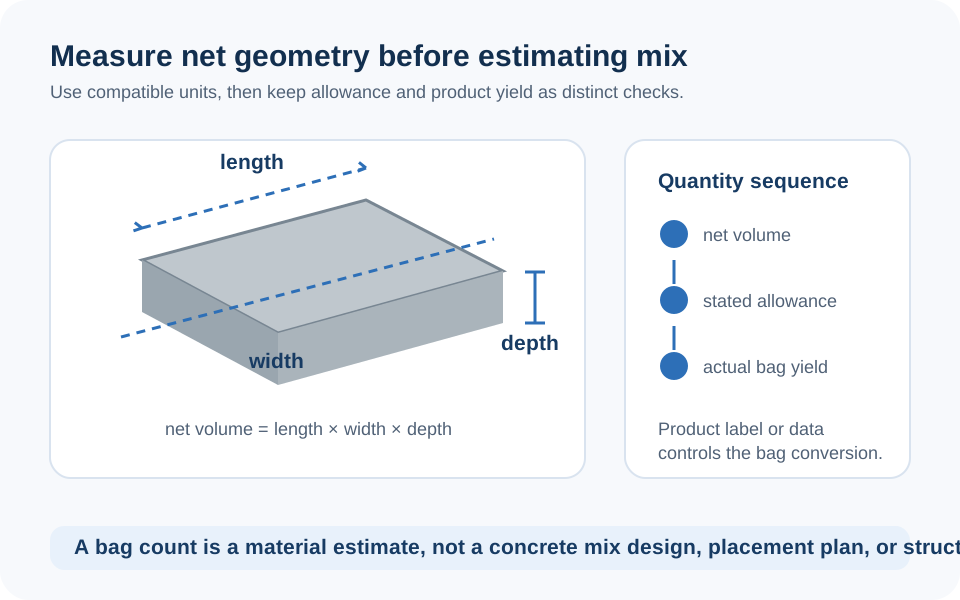
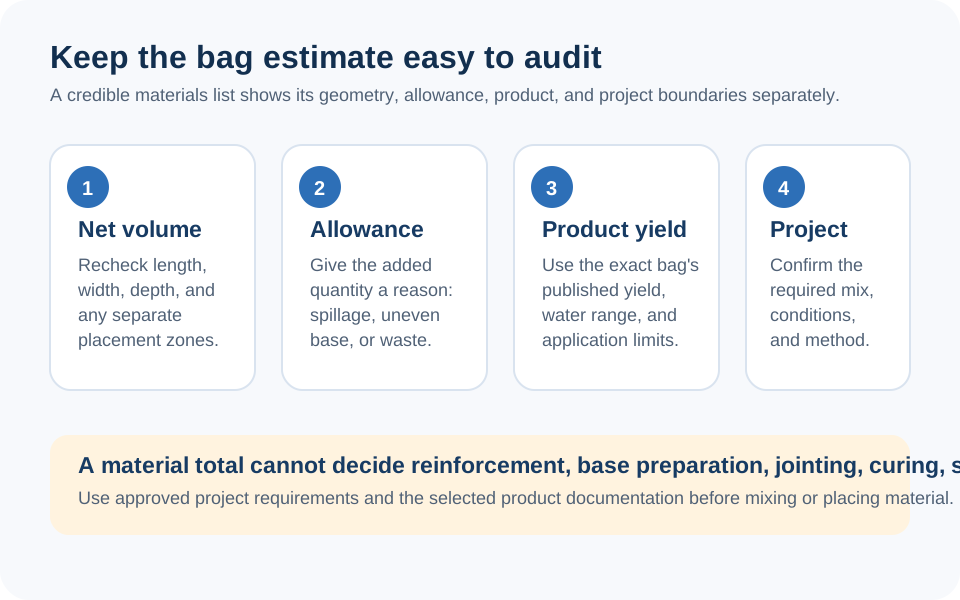
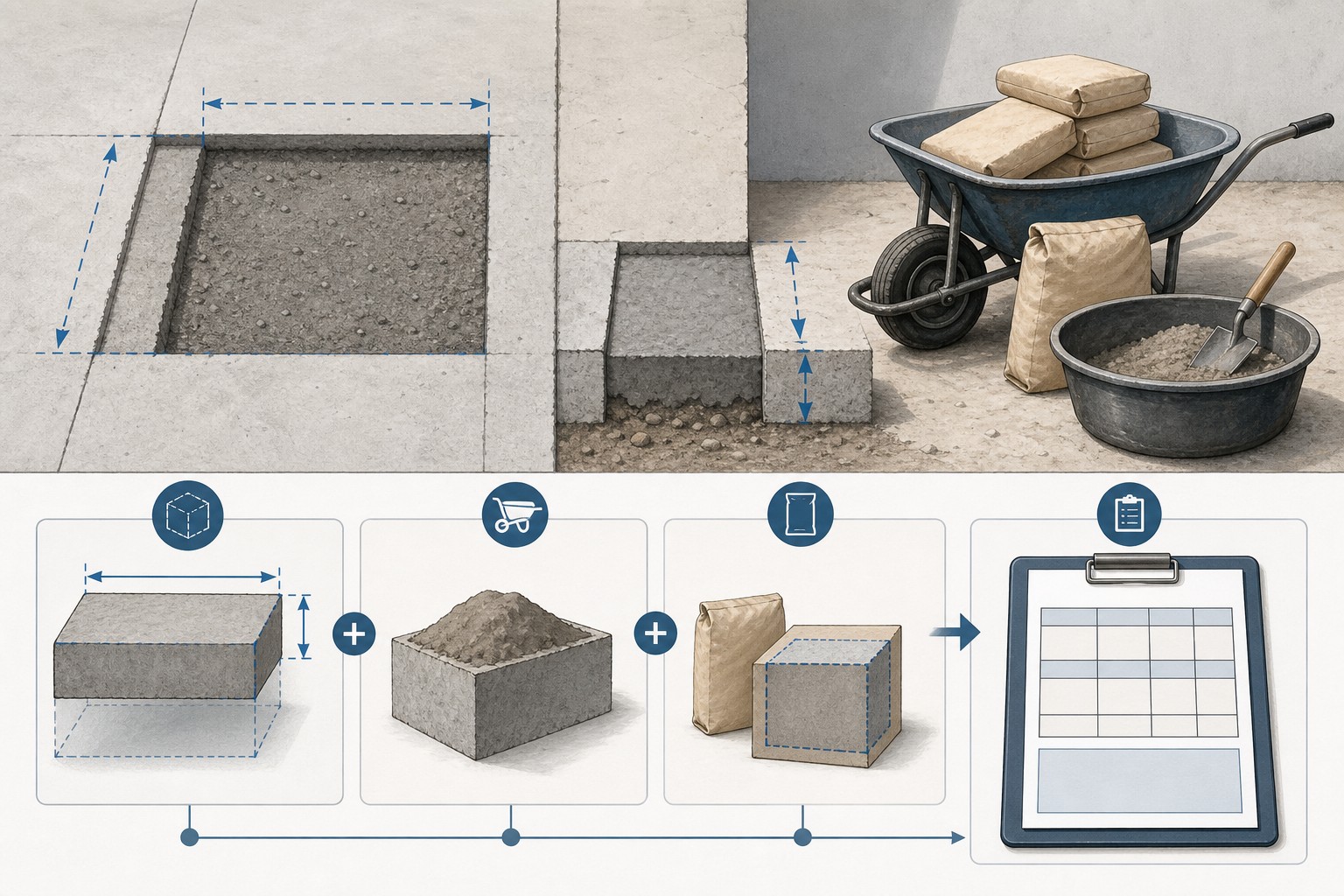
Start with wet volume (length times width times thickness), then multiply by a dry volume factor of about 1.54 to account for the air gaps in dry materials that close up once mixed with water. Split the resulting dry volume across cement, sand, and aggregate based on your mix ratio, then convert the cement portion into bags using your bag size (commonly 40 kg or 50 kg).
For example, a slab with 1 cubic meter of wet volume, using a 1:2:4 mix, needs about 1.54 cubic meters of dry volume. Cement's share (1/7) is roughly 0.22 cubic meters, which converts to about 6.3 bags of 50 kg cement. This calculator performs the dry-volume step and the ratio split automatically, so you avoid the shortfall that manual bag counts often cause.
Cement Sand Aggregate Ratio Calculator (1:2:4, 1:1.5:3, 1:3:6)
Mix ratio is expressed as cement to sand to aggregate, and determines both the strength and the cost of the finished concrete. A 1:1.5:3 mix is a richer, higher strength mix used for structural slabs and beams. A 1:2:4 mix is the standard general purpose ratio for most residential slabs and footings. A 1:3:6 mix is a leaner, lower strength mix suited to mass concrete, base layers, or non structural fill.
Select a preset ratio or enter a custom one, and the calculator splits the dry volume into cement, sand, and aggregate for you, showing each in both volume and weight along with the number of cement bags.
How Many Bags of Cement for a 1000 Sq Ft Slab?
Bag count for a given area depends on slab thickness and mix ratio, since a thicker slab or richer mix both increase cement demand. For a standard 4 inch (100 mm) thick slab using a 1:2:4 mix, 1000 sq ft of slab area works out to roughly 9.3 cubic meters of wet volume, requiring approximately 58 to 60 bags of 50 kg cement, before adding wastage.
Figures are planning estimates. Exact bag count depends on your specific mix design, bag size, and local material standards. Enter your own thickness and ratio into the calculator for a tailored figure.
Cement Calculator for Plastering
Plastering is calculated by area rather than slab volume, since it is a thin surface coat rather than a structural pour. Multiply wall or ceiling area by your plaster thickness (commonly 12 mm for internal walls, 15 to 20 mm for external walls), then apply a plastering specific mix ratio, typically 1:4 or 1:6 cement to sand, to find cement bags and sand volume required.
Switch the calculator to Plastering mode and it changes to an area based calculation with a lower dry-volume factor, matching how plastering material is actually estimated on site.
Mortar Calculator for Brickwork and Blockwork
Mortar for laying brick or block uses a different ratio than structural concrete, commonly 1:4 or 1:6 cement to sand, since mortar's job is bonding rather than load bearing strength. Mortar volume is typically estimated as a percentage of total wall volume (commonly 25 to 30 percent for standard brickwork joints), which the calculator applies automatically based on the mortar percentage you set.
Enter the wall length, height, and thickness, choose a mortar ratio, and the calculator returns the cement bags and sand volume needed for the joints.
Water Cement Ratio and Why It Matters
Water cement ratio is the weight of water divided by the weight of cement in a mix, typically between 0.4 and 0.5 for standard concrete. Too much water weakens the final cured strength of the concrete even though it makes the mix easier to pour, while too little water makes the mix difficult to work with and can leave weak spots from incomplete hydration.
The calculator estimates the water required from the cement weight and your chosen water-cement ratio, so getting this figure right is as easy as getting the cement, sand, and aggregate ratio right.