
US Paycheck Calculator
Estimate an annualized US paycheck scenario with federal income tax, selected state tax, Social Security, Medicare, and entered deductions. Compare the model with your paystub before making decisions.
Example Scenarios
$75k Texas
Single • Biweekly • 5% 401k
Hourly + OT
$25/hr • 8 OT hrs • FL
$10k Bonus
$85k salary • NY
TX vs CA Offer
$90k TX vs $100k CA
US Paycheck Inputs 2026 federal payroll model View Results
Paycheck Summary
Where Every Dollar Goes (per paycheck)
Per Paycheck vs Annual
| Item | Per Check | Annual |
|---|---|---|
| Gross Pay | $0 | $0 |
| Federal Tax | $0 | $0 |
| State Tax | $0 | $0 |
| Social Security | $0 | $0 |
| Medicare | $0 | $0 |
| Net Take-Home | $0 | $0 |
401k +1% Impact
Raise your 401k by 1% to see the paycheck effect…
How This Is Calculated
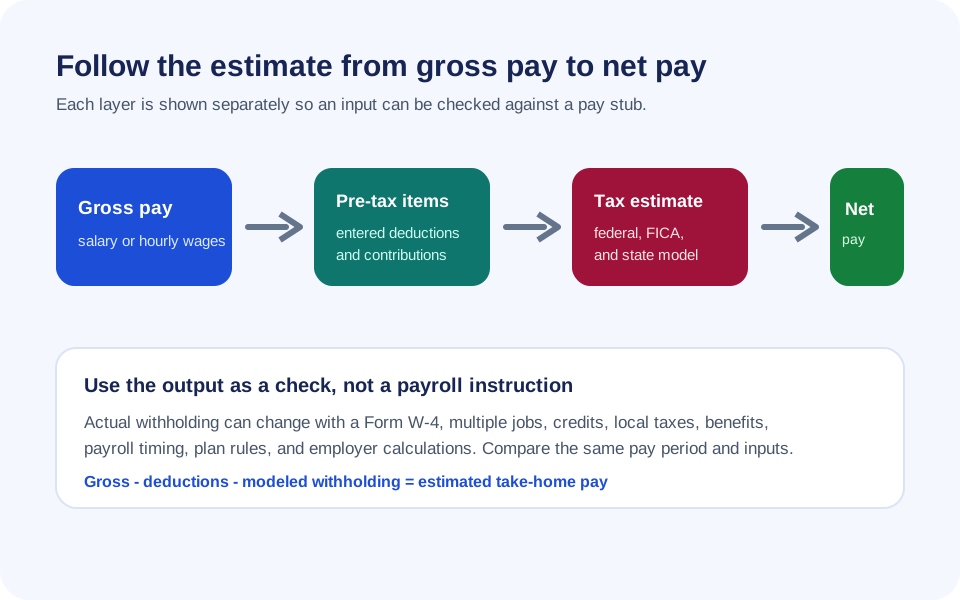
The annualized payroll-withholding estimate follows Gross − deductions → federal → FICA → state → post-tax. Qualified Section 125 HSA, FSA, and health deductions reduce FICA wages in this model; traditional 401k and generic other pre-tax deductions do not. Additional Medicare uses the employer $200,000 withholding threshold, not final Form 8959 liability. Results are planning estimates, not tax advice.
Check the method before you use the estimate
This page documents the formula, assumptions, and any specific external sources used for this tool.
See the methodPlanning estimate What this result can and cannot tell you
This calculator is an educational planning estimate, not financial advice, tax advice, legal advice, credit advice, or payroll advice. Confirm withholding, benefits, and tax filings with your paystub, employer, or a qualified professional.
How the US Paycheck Calculator works
These notes describe the calculation used on this page and the assumptions that can change a real-world result.
Annual net pay = annual gross pay - modeled federal income tax - simplified state planning value - Social Security withholding - Medicare payroll withholding - entered pre-tax deductions - entered post-tax deductions. Medicare payroll withholding includes a 0.9% employer-withholding estimate on modeled Medicare wages above $200,000. Net pay per period = annual net pay / selected pay periods.
Assumptions on this page
- Federal income tax is modeled annually from the supported filing status, standard deduction, and bracket table; it is not an employer's complete Form W-4 withholding calculation.
- Social Security and Medicare are annualized employee payroll-withholding estimates. The 0.9% Additional Medicare amount starts above $200,000 paid by an employer to an employee regardless of filing status; final Form 8959 liability can use different filing-status thresholds and other income.
- The HSA, FSA, and health-premium fields are treated as qualified Section 125 cafeteria-plan salary reductions for FICA. Traditional 401(k) and generic other-pre-tax fields remain subject to FICA in this model; confirm the actual plan treatment on a paystub or plan document.
- State values are simplified planning inputs rather than verified current state withholding tables. They do not determine local taxes, reciprocal agreements, credits, or state-specific payroll rules.
- Hourly mode annualizes the entered regular and overtime hours across 52 weeks; irregular schedules, bonuses, credits, and payroll timing are not fully modeled.
Sources used on this page
- IRS Publication 15-T, Federal Income Tax Withholding Methods Used to describe why a complete payroll withholding result requires Form W-4 and employer withholding methods beyond this annualized planning model.
- IRS Publication 15, Employer's Tax Guide Used for Social Security and Medicare payroll-withholding rules, including the employer $200,000 Additional Medicare withholding threshold and qualified cafeteria-plan wage treatment.
- IRS Topic no. 560, Additional Medicare tax Used to distinguish the employer's $200,000 withholding responsibility from final Additional Medicare Tax calculation on Form 8959 using filing-status thresholds.
- IRS Publication 15-B, Employer's Tax Guide to Fringe Benefits Used for the Section 125 cafeteria-plan limitation: excluded qualified benefits generally are not subject to federal income, Social Security, or Medicare withholding.
- IRS 2026 tax inflation adjustments Used to check the 2026 federal standard-deduction and bracket values represented in the calculator data.
Everything behind the US Paycheck Calculator
Formulas, reference charts, and detailed answers — expand any section you need.
Use the result as a transparent annualized estimate
A paystub is a record of a specific payroll run. This calculator is different: it turns the salary, filing status, state, frequency, and deductions you enter into one annualized planning scenario. It then divides the modeled annual net amount by the selected number of pay periods. That makes it useful for comparing an offer, testing a contribution change, or checking the arithmetic behind a rough budget. It does not know your employer's payroll system, Form W-4 elections, local tax jurisdiction, benefit plan, prior-year wages, or the timing of each check.
The selected state entry is a simplified planning value, not a verified current state withholding table. It cannot determine local income tax, reciprocal agreements, credits, or every state payroll rule. Start with a single scenario you can explain: annual salary, one filing status, one work state, and only deductions you can identify from an offer letter or paystub. Treat the result as a question to investigate rather than a promise of the next deposit. For a non-US or intentionally editable-rate scenario, use the Take-Home Pay Calculator; for a gross-pay conversion without tax assumptions, use the Salary Calculator.
What the gross-to-net sequence does
The model begins with annual gross pay. It subtracts the supported pre-tax values from the income-tax base, applies its federal bracket model after the selected standard deduction, adds a simplified state planning value, and separately estimates Social Security and Medicare payroll withholding. Finally, it subtracts entered post-tax deductions. The page shows those pieces so a visitor can see which assumption changed the answer instead of receiving a black-box number.
Some deductions do not affect every tax base in the same way. This model treats the HSA, FSA, and health-premium fields as qualified Section 125 cafeteria-plan salary reductions, so they reduce its Social Security and Medicare wage base. Traditional 401(k) contributions and the generic other-pre-tax field still count as FICA wages here. That is an assumption about the employer plan, not a rule that applies to every deduction. If a line on your paystub does not fit a field, leave it out rather than forcing it into the wrong category, and use the output only as a broader planning range.
A reproducible worked scenario
Consider a $75,000 annual salary, single filing status, Texas, biweekly pay, and a 5% pre-tax 401(k) contribution. The entered contribution is $3,750. With the calculator's 2026 federal table and its annual tax logic, the scenario models $6,845 of federal income tax, $4,650 of Social Security, $1,087.50 of Medicare, and $0 of state income tax. The modeled annual net is $58,667.50, or about $2,256.44 across 26 pay periods.
This is deliberately a model walkthrough, not a statement of what any employee will receive. A real check can change because withholding is calculated per payroll, wages can cross the Social Security cap during the year, benefits may be taxable differently, and federal withholding can reflect W-4 entries and multiple-job adjustments. Re-run the scenario with the figures on a real paystub and compare each line, rather than comparing only the final net number.
Why pay frequency changes the visible check, not annual gross pay
Weekly pay has 52 scheduled periods, biweekly pay has 26, semi-monthly pay has 24, and monthly pay has 12. A $75,000 annual salary therefore has a gross amount of about $1,442.31 weekly, $2,884.62 biweekly, $3,125 semi-monthly, or $6,250 monthly before deductions. Biweekly and semi-monthly are commonly confused: one is every two weeks and normally produces two extra checks in a year.
Because this page annualizes before dividing, it is best at explaining an annual scenario consistently across frequencies. A payroll provider may withhold a different amount on an individual check than this simple division suggests. That can be especially noticeable with bonuses, commission, overtime, mid-year starts, or a change to benefits. The Budget Calculator can help translate the more conservative monthly amount into spending categories.
Federal withholding, final tax, and payroll taxes are different questions
Federal withholding is money an employer sends to the IRS during the year. Final income tax is determined on a tax return after income, deductions, credits, and filing facts are known. Social Security and Medicare are payroll taxes with their own rules. A high withholding amount on a particular check is therefore not enough to tell whether a person will owe or receive a refund.
Additional Medicare makes the distinction especially important. Employers must generally begin the 0.9% Additional Medicare withholding once they pay more than $200,000 to an employee in a calendar year, regardless of that employee's filing status. A taxpayer's final Additional Medicare Tax is calculated on Form 8959 and can use filing-status thresholds and other income. This page shows the first as an annualized payroll-withholding estimate; it does not calculate final Form 8959 liability.
The official IRS Publication 15-T contains the payroll withholding methods and illustrates why a general calculator cannot reproduce every employer result. The IRS Tax Withholding Estimator is a more appropriate official starting point for checking federal withholding elections. This page is most useful for understanding the direction and size of an entered change, such as a raise or a retirement contribution.
Use deductions as assumptions, not recommendations
A pre-tax 401(k) contribution can lower the model's federal taxable income, which is why its reduction in take-home pay may be less than its face value. It remains subject to Social Security and Medicare wages in this model. By contrast, the HSA, FSA, and health-premium fields reduce FICA only under the page's qualified Section 125 cafeteria-plan assumption. Do not select a field based only on the word “pre-tax”; check how the employer actually reports that deduction.
That observation does not say how much anyone should contribute. The account may have an employer match, vesting rules, investment options, fees, withdrawal limits, and plan-specific contribution definitions that this paycheck calculation does not assess. Enter a known percentage or dollar amount only when it reflects a real choice or benefit election. Then examine it alongside the 401(k) Calculator, which separates employee contributions, eligible employer-match assumptions, and long-term growth assumptions. If the calculation is for an offer, preserve the inputs in a note and ask the employer which deductions, health premiums, transit benefits, local taxes, and payroll frequency will actually apply.
A short checklist before relying on the result
Check the salary basis first: annual salary, hourly wage, and overtime assumptions should not be mixed. Confirm whether a retirement contribution is pre-tax or Roth, whether insurance is payroll-deducted, and whether your location has local taxes. Select the filing status that matches the planning scenario, but do not assume a state selection covers every state-specific rule. Finally, compare the modeled annual taxes and deductions to a current paystub or official document line by line.
If you find a formula, wording, accessibility, or output problem, use the page's Report an issue control. A useful report includes the calculator name, the input values that can be shared safely, the result observed, and what appeared inconsistent. Do not put Social Security numbers, bank details, employer account credentials, or other sensitive information in a report.