
Salary vs. Hourly Pay: How to Compare Your Take-Home Income
Compare salary and hourly offers using paid hours, actual working hours, overtime eligibility, paid time off, benefits, and transparent U.S. paycheck assumptions.

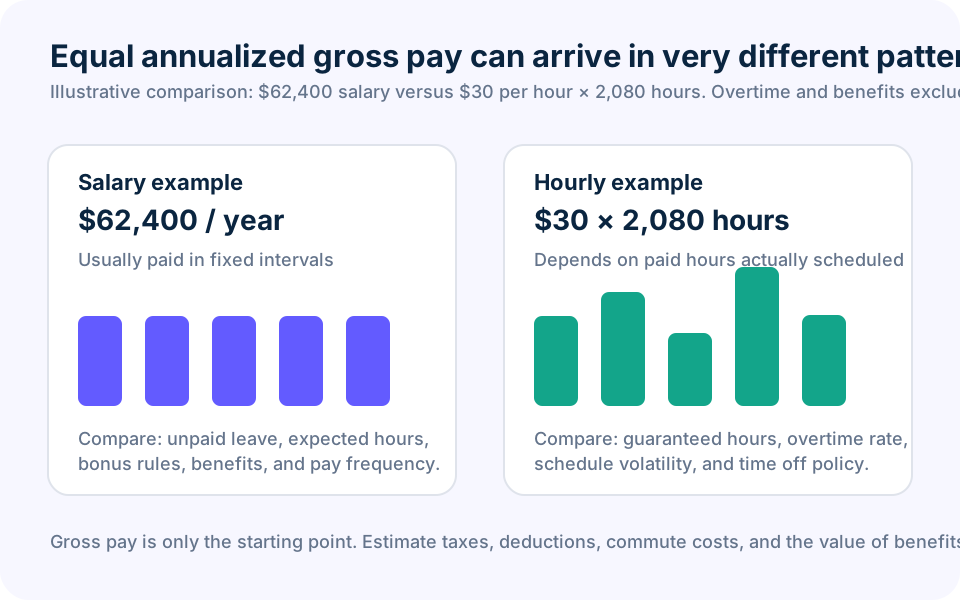
An annual salary and an hourly rate cannot be compared fairly until you define the hours and benefits behind each number. The familiar 2,080-hour conversion is useful, but it assumes 40 paid hours for 52 weeks. It does not tell you whether time off is paid, whether overtime applies, how many hours are actually expected, or what will be withheld from a paycheck.
This guide creates a transparent comparison rather than declaring that salary or hourly work is inherently better. Use the Salary Calculator for unit conversions, then use a written assumption sheet before comparing two actual offers.
U.S. scope: The payroll and overtime references on this page are U.S.-specific. A salary title does not, by itself, prove that a job is exempt from overtime, and an hourly title does not, by itself, guarantee overtime eligibility.
Use 2,080 hours as a starting convention
For a full year with 40 paid hours each week, the conventional conversion is:
A $62,400 salary divided by 2,080 is $30 per hour. That is only a gross-pay conversion. It says nothing about whether the role has paid leave, a bonus, health coverage, retirement matching, unpaid closures, overtime, commuting cost, or an expectation of longer hours.
Separate paid hours from hours actually worked
Use two columns in every offer comparison:
| Question | Why it changes the comparison |
|---|---|
| How many hours are paid each year? | Hourly workers may have unpaid leave, shutdowns, or variable schedules. Salaried workers may have paid leave or may not. |
| How many hours are expected to be worked? | Dividing annual gross pay by actual expected hours produces an effective gross hourly rate. |
| Are overtime hours legally eligible and paid? | For covered nonexempt U.S. employees, federal law generally requires overtime above 40 hours in a workweek. Classification and state rules matter. |
| Which benefits have an employer cost or employee deduction? | Health coverage, retirement matching, paid leave, bonuses, and commuting support can change the economic value of an offer. |
Worked comparison: three stated schedules
The following is a gross-pay illustration, not a job-offer recommendation. It deliberately changes only the schedule assumptions so the reader can see why a headline rate is incomplete.
| Scenario | Stated pay | Paid-hours assumption | Illustrated annual gross pay |
|---|---|---|---|
| Salary role | $62,400 salary | 52 paid weeks; 40 expected hours each week | $62,400 |
| Hourly role with two unpaid weeks | $30.00 per hour | 40 hours × 50 paid weeks | $60,000 |
| Hourly role with regular overtime | $30.00 per hour | 40 regular hours plus 5 overtime hours × 52 weeks, only if covered and eligible | $74,100 at time-and-a-half overtime |
The third row uses $30 × 40 = $1,200 regular pay plus $45 × 5 = $225 overtime pay per week, or $1,425 × 52. It is not a prediction of what any employer must pay. It demonstrates why the written overtime classification, schedule, and applicable law are more important than the label “salary” or “hourly.”
Calculate an effective gross hourly rate
A second comparison can ask: “What is annual gross pay per hour actually worked?” If the $62,400 salary role is expected to require 50 hours each week for all 52 weeks, the illustration is:
This does not mean every salaried employee works 50 hours or that an hourly job is better. It reveals why expected workload belongs beside the offer amount. Use the same method for unpaid prep time, on-call requirements, uncompensated travel time, and variable weeks where those facts are relevant.
Gross pay is not take-home pay
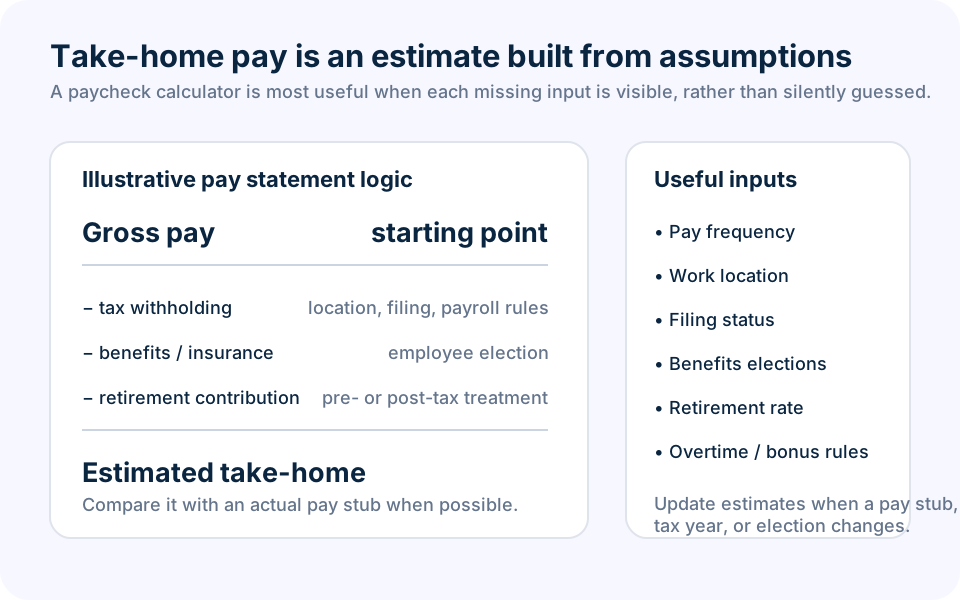
Take-home pay begins with gross wages and then changes with federal, state, and local withholding, Social Security and Medicare withholding where applicable, health-plan premiums, retirement contributions, wage garnishments, and other elections. Tax rules and payroll rates can change, and the correct result depends on a person’s location, filing situation, deductions, other income, and pay frequency.
Do not estimate an “exact” paycheck by subtracting one universal percentage. For a U.S. federal withholding check, the IRS directs workers to its Tax Withholding Estimator and asks for current pay-stub information. For a planning estimate, enter the location, pay frequency, and stated deductions in the US Paycheck Calculator, then compare that output with an actual pay stub when one is available.
An offer-comparison checklist
Before assigning a winner to two offers, collect the same facts for both:
- Base pay, pay frequency, and expected start date.
- Normal scheduled hours, expected busy-period hours, and whether time is paid.
- Written overtime classification and applicable state or local rules.
- Paid holidays, paid leave, shutdowns, sick leave, and unpaid leave policies.
- Employer contributions and employee deductions for health coverage, retirement, bonuses, equity, commuting, equipment, and training.
- Location, work arrangement, and recurring costs that differ between the roles.
Then model separate scenarios rather than blending the assumptions. A “40-hour, all weeks paid” scenario and a “variable schedule with unpaid time” scenario can both be useful, as long as the page labels them clearly.
Use calculators for the arithmetic, not the employment classification
Use the Salary Calculator to convert among hourly, weekly, monthly, and annual gross pay. Use the Take-Home Pay Calculator or US Paycheck Calculator for a clearly labeled planning estimate. A calculator cannot determine whether a worker is exempt, which benefits will be offered, or which option is best for a particular person.
Scope and limitations
This is general educational information, not legal, tax, employment, or personalized financial advice. The labor and tax references are U.S.-specific. Employment classification, overtime, tax treatment, benefit eligibility, local law, and contract terms can materially change the comparison. Review the written offer and seek qualified local help for an individual legal or tax question.
Sources and assumptions
These links support the specific material, product, or reference points used in this guide. Local conditions and supplier specifications can still vary.
- U.S. Department of Labor — Overtime Pay Explains the federal overtime baseline for covered nonexempt employees. State law, job duties, exemptions, and employment agreements can change the analysis.
- U.S. Department of Labor — Handy Reference Guide to the Fair Labor Standards Act Provides examples of regular-rate and overtime concepts. It does not determine an individual worker’s classification.
- Internal Revenue Service — Tax Withholding Estimator Official U.S. tool for reviewing federal income-tax withholding using current pay stubs and personal tax information.
- Internal Revenue Service — Publication 15, Employer's Tax Guide Current-year U.S. employer payroll-tax reference. Do not hard-code rates from a past tax year into a general comparison.