
The 50/30/20 Budget Rule: How to Divide Your Paycheck
Use the 50/30/20 rule as a practical check on your take-home pay, fixed bills, irregular expenses, savings, and extra debt payments.

The 50/30/20 budget is most useful when it is treated as a diagnostic, not a scorecard. It gives your take-home pay three jobs: cover essentials, leave room for chosen spending, and make progress on savings or extra debt repayment. If your real numbers do not fit the percentages today, that is information about your current cash flow—not proof that you have failed at budgeting.
This guide uses the same three-bucket math as the 50/30/20 Budget Calculator, then adds the work many short explanations skip: deciding which number to start with, handling irregular bills, and pressure-testing a budget before the month begins.
Use take-home pay. Start with money that is actually available to your household after payroll withholding and deductions. If you also save through a payroll retirement contribution, record it separately so you can see the full picture without counting the same dollars twice.
What the three buckets are for
With monthly take-home pay of N, the starting targets are:
The framework is simple. Classifying a real expense is the harder and more valuable part.
Needs: costs that keep the household functioning
Needs usually include housing, basic utilities, groceries, required transportation, insurance, child care needed to work, and required minimum debt payments. A need is not necessarily a fixed price: a basic phone plan may be necessary while a premium upgrade may be optional. The goal is not to argue about every category; it is to choose a definition you will use consistently from month to month.
Wants: chosen spending after essentials are covered
Restaurant meals, travel, entertainment, hobbies, subscriptions, optional upgrades, and convenience spending are common examples. A wants category is not a punishment category. It lets you choose what matters after essential commitments and longer-term goals have a place in the plan.
Savings and extra debt payoff: money assigned to a future job
This bucket can include an emergency reserve, a planned annual cost, retirement saving, a near-term goal, or payments above the required minimum on debt. The important distinction is that a required minimum payment belongs with needs, while an optional amount paid above that minimum belongs in this third bucket.
Build the budget from evidence, not memory
Before applying percentages, collect three recent months of bank, card, and bill records. The Consumer Financial Protection Bureau recommends looking at income, spending, and bill timing together because a budget can look affordable for a month while still fail when a quarterly or annual bill arrives.
- Find a realistic monthly income number. For steady pay, use the average actual deposits. For variable pay, write down a conservative month and a typical month separately rather than pretending they are the same.
- List committed payments and their due dates. Housing, minimum debt payments, insurance, utilities, transport, and other obligations need both an amount and a date.
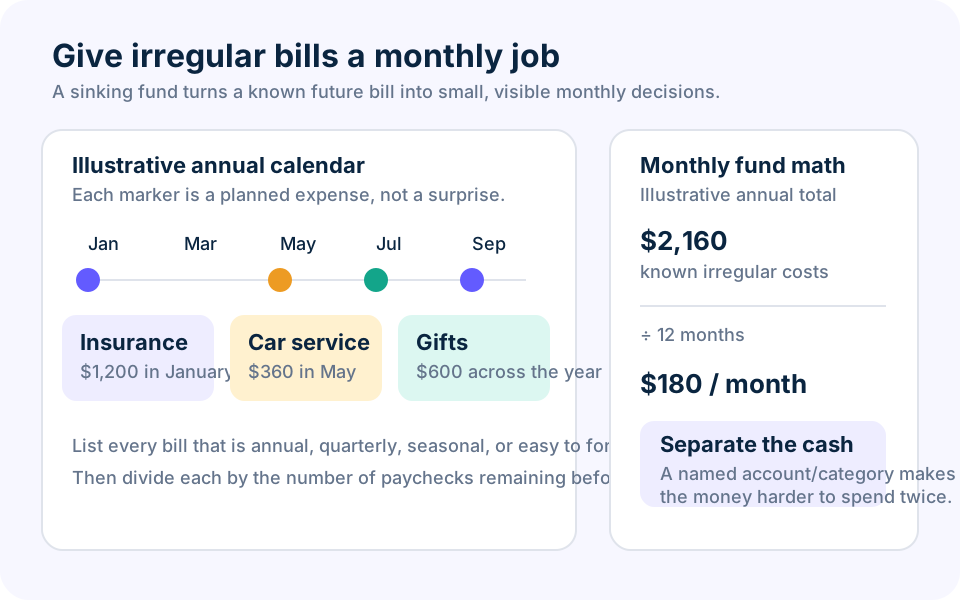
- Turn irregular costs into monthly provisions. Divide a known annual or quarterly cost by the number of months until it is due. This does not make the bill cheaper; it prevents it from being invisible.
- Classify the remaining transactions. Use a short note for ambiguous items. For example, label a grocery-delivery fee as a convenience cost if the food itself is a need.
Worked example: a $4,000 take-home month
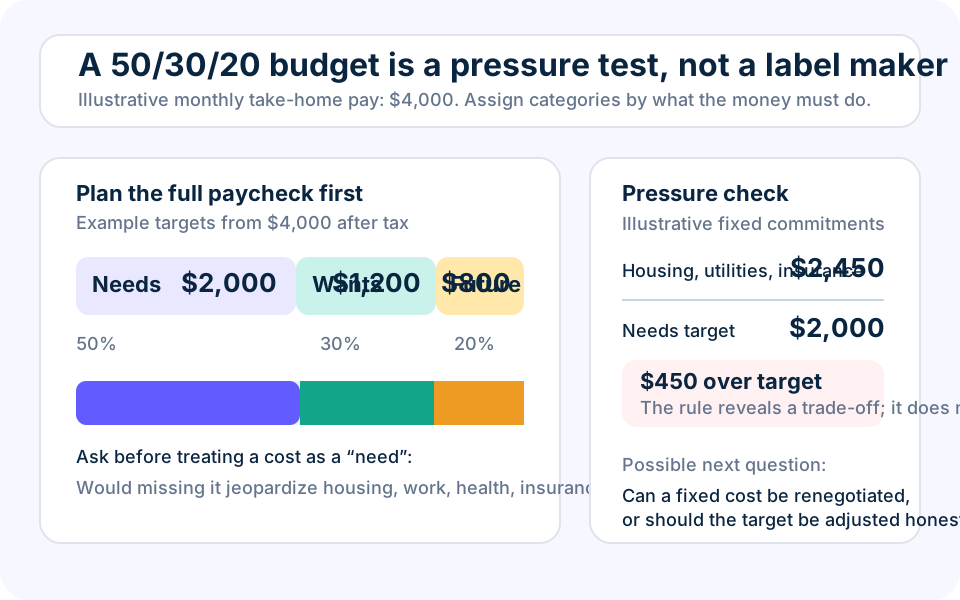
Suppose a household has $4,000 available after regular payroll deductions. The starting 50/30/20 targets are $2,000 for needs, $1,200 for wants, and $800 for savings or extra debt payments.
| Bucket | Starting target | Example allocation | What to check |
|---|---|---|---|
| Needs | $2,000 | $1,350 housing, $310 groceries, $190 utilities and phone, $150 transport | Are required minimum debt payments and insurance included? |
| Wants | $1,200 | $260 meals out, $90 subscriptions, $250 hobbies and outings, $600 unassigned flexibility | Does the flexible amount get spent intentionally or disappear? |
| Savings / extra debt | $800 | $300 emergency reserve, $120 annual car-insurance provision, $180 retirement contribution, $200 extra debt payment | Is each dollar assigned to a named future cost or goal? |
The example is deliberately not a universal lifestyle template. Its value is the sequence: calculate the targets, list actual obligations, then show the gap between a target and reality.
Make irregular expenses visible
Many budgets look balanced because they include only bills that happen every month. A practical budget also creates a monthly provision for costs such as annual insurance, school supplies, car registration, gifts, medical copays, maintenance, or seasonal utility peaks.
For example, if an $840 insurance premium is due in seven months and no money has been set aside, the monthly provision is:
That $120 is not a surprise spending category. It is part of the actual cost of owning the insured item. Adding it to the budget may push the needs bucket above 50%, which is exactly the kind of useful result a pressure test should reveal.
What to do when needs are above 50%
A needs percentage above 50% is common during a move, an income change, a high-cost housing period, medical care, or required debt repayment. Do not cover the gap by silently deleting savings, ignoring annual bills, or categorizing every expense as a want. Instead, write down a temporary plan that shows what is changing and for how long.
- Keep required payments current and preserve a small cash buffer where possible.
- Compare a conservative month with a typical month if income changes from pay period to pay period.
- Review optional recurring costs first, because they are easier to change than rent or a contract payment.
- Use a separate decision process for major changes such as housing, debt refinancing, employment, or investment choices. A percentage rule alone cannot make those decisions.
Use the calculator as a monthly check-in
Enter your available monthly income in the 50/30/20 Budget Calculator, then compare its three target amounts with the expenses you actually expect this month. For a broader list of categories and bill timing, use the Budget Calculator. If you need to understand why your deposit differs from gross pay, start with the Take-Home Pay Calculator.
Scope and limitations
This is general educational information, not individualized financial, tax, debt, or investment advice. The 50/30/20 split is a flexible framework, not a legal, regulatory, or universally appropriate standard. Tax treatment, benefits, debt terms, household size, local costs, and financial priorities can materially change a sensible plan.
Sources and assumptions
These links support the specific material, product, or reference points used in this guide. Local conditions and supplier specifications can still vary.
- Consumer Financial Protection Bureau — Analyzing Budgets Explains the 50/30/20 framework and uses net income as the starting point. It is an educational budgeting framework, not a personal financial recommendation.
- Consumer Financial Protection Bureau — Budgeting: How to Create a Budget and Stick With It Supports the process of recording income, spending, bill due dates, and realistic recurring costs before setting a budget.
- U.S. Bureau of Labor Statistics — Consumer Expenditure Surveys Provides national household-spending research. It is context only; national averages are not an appropriate target for an individual household.