
How to Calculate Compound Interest: The Step-by-Step Growth Formula
Learn the compound-interest formula, separate rate from contribution timing, and read a growth projection with clear inflation, tax, fee, and uncertainty limits.

Compound interest means that a later interest calculation can be based on an earlier interest credit as well as the original balance. The mathematics is straightforward; the interpretation is where many projections become misleading. A projection needs to state the rate, the compounding frequency, the timing of every contribution, the time horizon, and what it leaves out.
This guide separates those ingredients. It uses the same core model as the Compound Interest Calculator, but it does not present an assumed rate as a promise of investment performance or account yield.
Projection, not prediction: A compound-interest result shows what the specified inputs would produce. It cannot tell you what a market investment will return, what a bank will pay in the future, or what you will have after taxes, fees, withdrawals, or inflation unless those inputs are explicitly modeled.
The lump-sum compound-interest formula
For one starting amount with no additional deposits or withdrawals, the standard formula is:
- A is the ending amount in the model.
- P is the starting principal.
- r is the annual rate written as a decimal, such as 0.06 for 6%.
- n is the number of compounding periods per year.
- t is the number of years.
This formula is for a lump sum. If you add money every month, each deposit has a different amount of time to earn interest. A calculator handles that by applying interest and contributions period by period, rather than pretending every contribution was present on day one.
Worked example: same rate, two compounding frequencies
Assume an initial $10,000, a 6% annual rate, no additional deposits, and a 10-year period. The example uses the stated nominal rate and makes no claim that 6% will be available from a particular product.
| Assumption | Calculation | Modeled ending amount |
|---|---|---|
| Annual compounding | $10,000 × (1 + 0.06)10 | $17,908.48 |
| Monthly compounding | $10,000 × (1 + 0.06 ÷ 12)120 | $18,193.97 |
Monthly compounding produces a higher result in this example because the same nominal 6% rate is applied in more periods. When comparing real accounts, however, do not look only at the word “daily” or “monthly.” Compare the complete stated rate, APY or equivalent disclosure, fees, balance rules, withdrawal limits, and term.
Contribution timing changes the result
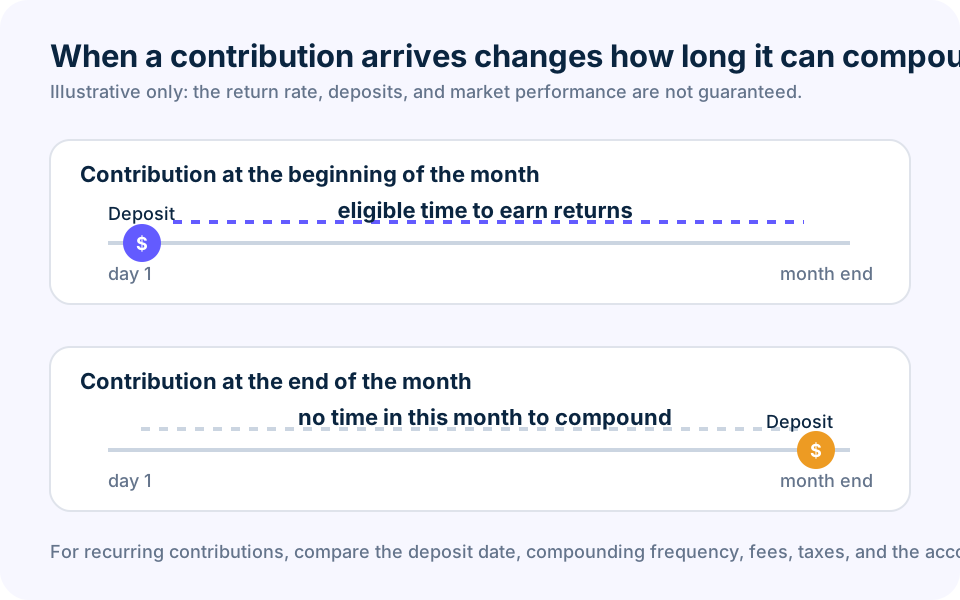
Suppose you plan to add $200 every month. A deposit made at the beginning of the month has one more month of modeled growth than the same deposit made at the end. A projection should therefore identify whether contributions are assumed at the beginning or end of each period.
- Beginning-of-period contribution: deposit first, then apply that period’s interest.
- End-of-period contribution: apply that period’s interest to the existing balance, then deposit.
- Irregular contribution: use the actual dates or a simple dated ledger instead of forcing the plan into a monthly average.
Neither timing convention is morally better. The useful approach is to choose the one that matches how money actually arrives in the account and label it in the example.
How to read compounding frequency
Compounding frequency tells you how often the model applies a stated rate to the balance. Annual compounding uses one period per year; quarterly uses four; monthly uses twelve; daily uses roughly 365. It matters when the nominal rate is held constant. It does not mean an account with daily compounding is automatically better than an account with a different quoted rate or fee structure.
For a loan or credit-card balance, compounding can work in the other direction: interest can be added to an amount you owe. The calculation method, daily balance rules, grace periods, payment application, fees, and promotional terms can matter as much as the headline APR. Use account disclosures rather than importing an investment example into debt math.
The Rule of 72 is a quick approximation
The Rule of 72 estimates a doubling time by dividing 72 by an annual percentage rate:
At 6%, the shortcut gives about 12 years. It is a mental estimate, not a substitute for a schedule: its accuracy depends on the rate and compounding assumptions, and it does not include contributions, taxes, fees, or changes in rate.
Use a real-return lens as well as a dollar lens
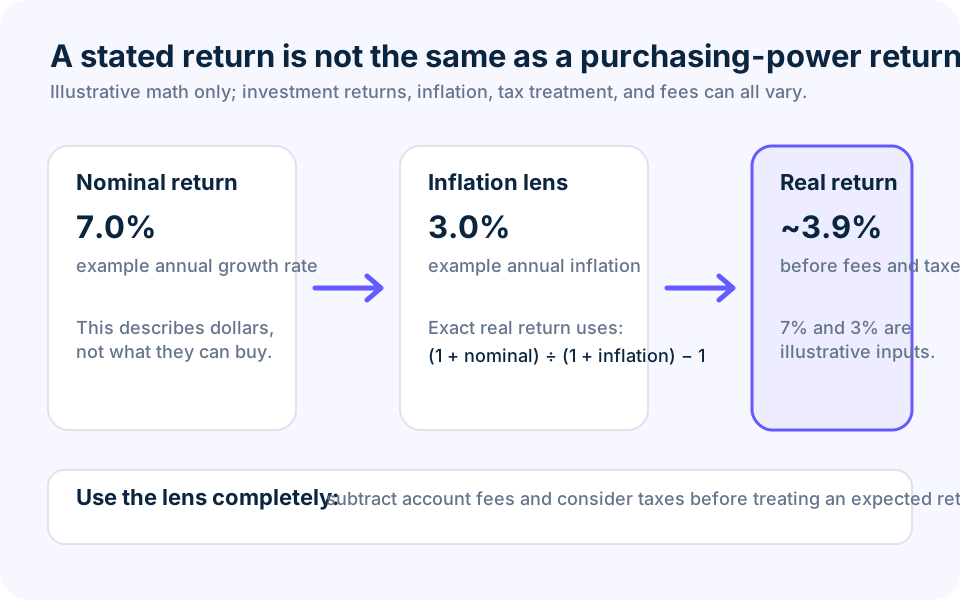
An ending balance is measured in future dollars. Purchasing power can change if prices change. A useful long-term illustration can therefore show two separate lines: the nominal ending balance under the chosen rate and a hypothetical inflation-adjusted value under a separately stated inflation assumption. Keep the assumptions visible and do not treat either line as a forecast.
For U.S. context, the Consumer Price Index is a source of historical inflation data, but historic CPI data does not establish a future rate for a personal plan. Taxes and account fees can also reduce what remains available to spend.
Run a transparent scenario
Use the Compound Interest Calculator to test a starting amount, contribution amount, timing, rate, compounding frequency, and years. Then change only one assumption at a time. For example, compare a smaller contribution started now with a larger contribution delayed for two years, while holding the rate and time horizon constant. That comparison explains the mechanics without claiming a particular result is likely.
For a loan or savings account with a stated rate but no regular contributions, the Interest Calculator can provide a simpler starting view. Always compare a calculator result with the product’s current disclosure or loan agreement.
Scope and limitations
This page is general educational information, not investment, tax, lending, or personalized financial advice. Investor.gov and BLS sources are U.S.-based. Investment returns can be negative or volatile; deposit-account yields can change; and taxes, fees, inflation, withdrawal rules, and account terms can materially alter results.
Sources and assumptions
These links support the specific material, product, or reference points used in this guide. Local conditions and supplier specifications can still vary.
- Investor.gov — What Is Compound Interest? Explains compounding and presents the Rule of 72 as an approximation, not a guarantee. Investor.gov is operated by the U.S. Securities and Exchange Commission.
- Investor.gov — Compound Interest Calculator Illustrates the inputs that change a projection: starting amount, recurring contribution, time, estimated rate, and compounding frequency.
- U.S. Bureau of Labor Statistics — Consumer Price Index Provides U.S. inflation data for a clearly labeled purchasing-power discussion. It does not predict future inflation or investment returns.